Be honest with me — how many highlighters have you bought this semester? Three? Five? And how many of your handout pages are now glowing yellow from top to bottom, looking "studied" but teaching you absolutely nothing the night before the paper? If that stung a little, welcome — you are in very good company.
Here is the uncomfortable truth nobody tells you: highlighting is not studying. Running a marker over a page feels productive. Your hand moves, the page changes colour, and your brain whispers, "kaam ho gaya." But when the paper is sitting in front of you, the page in your memory is just... yellow. All of it. Equally important. Which means none of it is.
Today I am giving you the system that fixes this forever. It is called the Color-Code Method — a simple 4-colour system that turns your VU handouts into a revision map. Definitions get one colour, formulas another, examples a third, and exam warnings the fourth. When the night before the paper arrives, you will not re-read 300 pages. You will read the colours. Let me show you exactly how.
Why Most Highlighting Is Just Decoration
Think about the last page you highlighted. Go on, picture it. How much of it is yellow? Half the page? More? Now ask yourself the honest question: when you look at that page, does your eye know where to land — or does it wander across a sea of yellow, tired and lost?
The problem is simple: when everything is marked, nothing is marked. Your brain is brilliant at one thing — noticing differences. A single pink line on a white page screams for attention. But a page that is entirely yellow is just a yellow page. There is no signal left, only noise.
This is why so many students highlight for hours and still feel unprepared. They did the work of a painter, not a student. Highlighting is supposed to be a filter — it should shrink each page down to the 10% that actually matters. The Color-Code Method does exactly that, and the four colours tell you why each marked line matters.
The 4-Colour System (Memorize This)
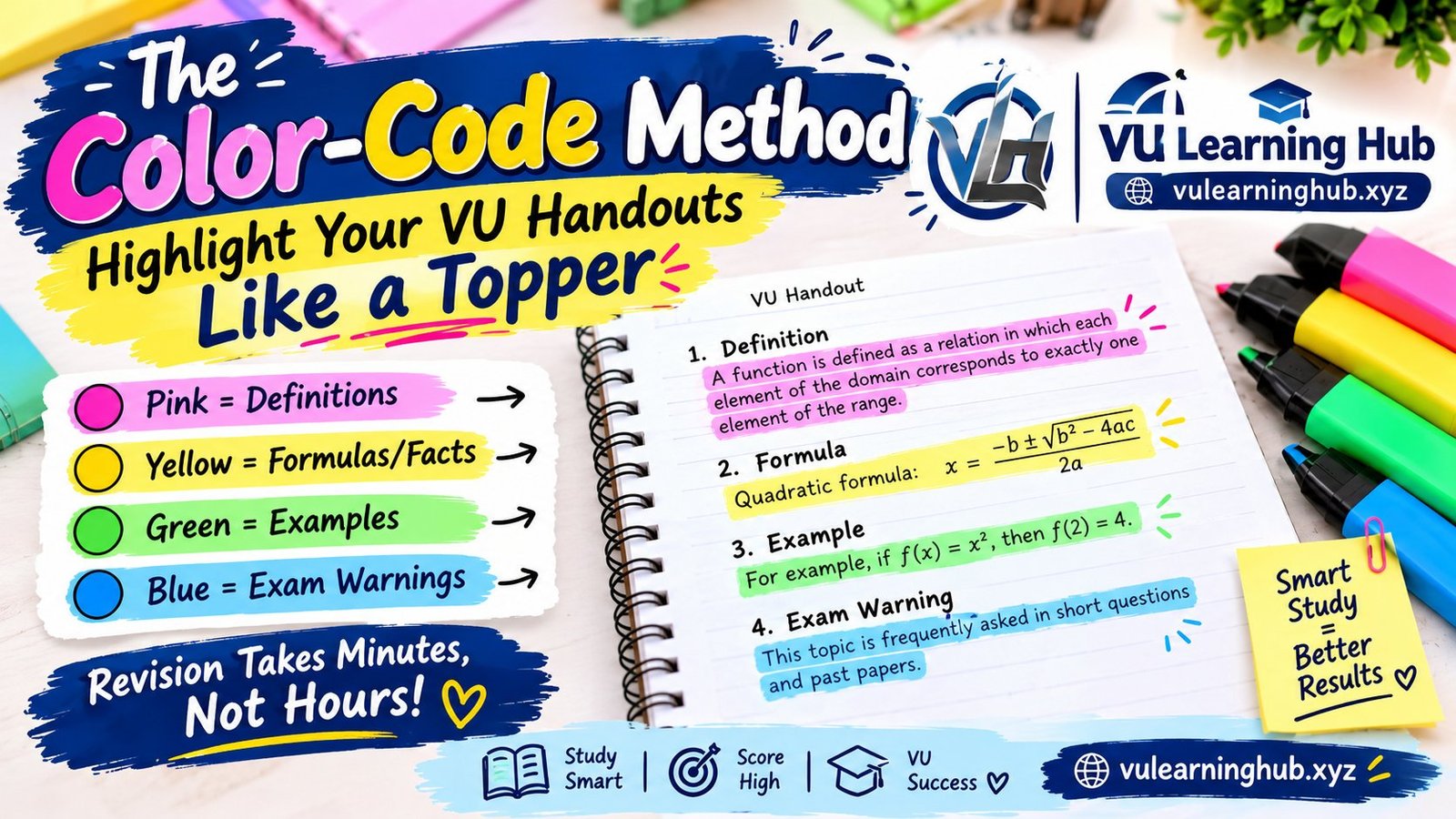
You need exactly four colours. Not twelve, not a rainbow stationery set — four. Each colour has one job, and the job never changes, no matter which subject you are studying. Here is the code:
PINK = Definitions. Any line that says "X is defined as..." or "X refers to..." gets pink. These are the lines that walk straight into short questions.
YELLOW = Formulas, facts and figures. Every formula, every number, every date, every "how many" fact. Yellow is your memory fuel.
GREEN = Examples. The little stories and worked examples that make a dry concept click. When a concept confuses you, green is where you go for rescue.
BLUE = Exam warnings. Anything your instructor flagged as important, anything that keeps repeating in past papers, anything that looks tricky. Blue is your exam hit-list.
That is it. Four colours, four meanings, every subject, every handout. And here is the real magic: the magic is not in the colours themselves. It is in the decision you make every time your marker hovers over a line — "What IS this line? A definition? A fact? An example? A warning?" That tiny moment of thinking is real studying. The colour is just the receipt.
A Worked Example: One CS101 Paragraph, Three Colours
Let me show you the method on a real paragraph. Imagine this is sitting in your CS101 handout:
"An algorithm is a step-by-step procedure for solving a problem. For example, a recipe is an algorithm. The efficiency of an algorithm is measured in terms of time and space complexity — a favourite exam topic."
Now watch the colours go to work:
PINK: "An algorithm is a step-by-step procedure for solving a problem." — That is a definition, the exact kind of line that appears as a short question.
GREEN: "For example, a recipe is an algorithm." — An example. If the word "algorithm" ever confuses you, this green line will rescue you in ten seconds.
BLUE: "time and space complexity — a favourite exam topic" — A warning. The handout itself is waving a flag at you: this gets asked. Blue it.
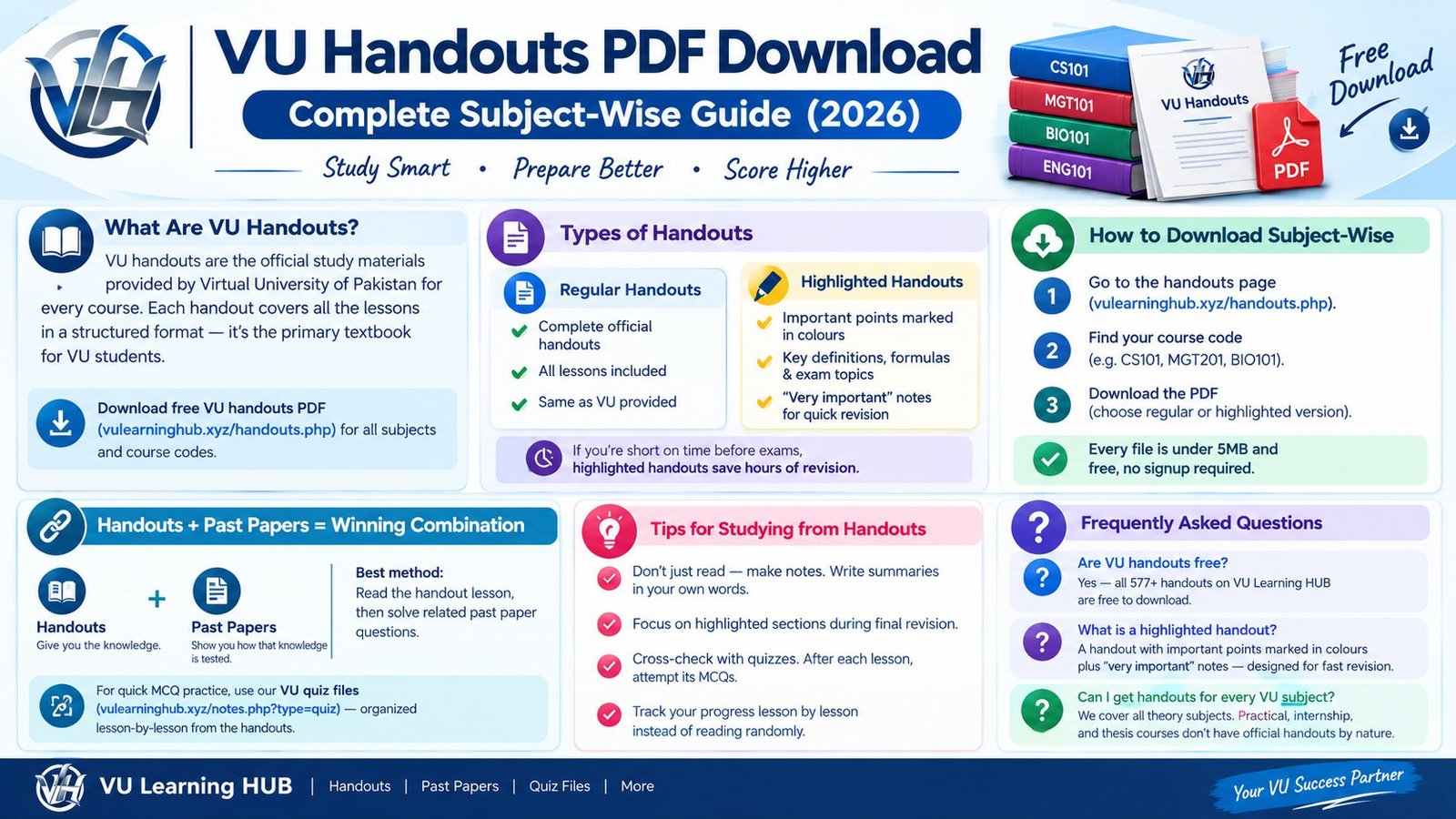
Notice what we did not mark: the connecting words, the filler, the scaffolding around the ideas. One paragraph, three colours, three different purposes. Now imagine your entire handout looking like this. Grab any handout from our Handouts section (https://vulearninghub.xyz/handouts.php) and try the method on your very next lecture — you will feel the difference immediately.
The Three Golden Rules (Break These and the Method Dies)
The system only works if you respect three rules. They are non-negotiable.
Rule 1 — Never highlight on the first read. Read the lecture first to understand it. Highlighting while reading for the first time is like packing for a trip before checking the weather — you will mark the wrong things. First read for understanding; second pass for colours.
Rule 2 — Mark key phrases, not whole lines. Your pink mark should cover the definition itself, not the entire sentence around it. If your highlighter travels more than a few words, stop and ask: which exact words would I write in the paper? Mark only those.
Rule 3 — Maximum five or six marks per page. This is the hard one. If a page has twenty highlights, you have not filtered anything — you have painted. Discipline here is what turns 300 pages into a 40-minute revision.
Follow these three rules and something beautiful happens: your handout becomes a map where pink shows you what to memorize, yellow shows you what to practise, green shows you where to find understanding, and blue shows you exactly where the examiner is aiming.
The Night-Before-Paper Trick (This Is Where It Pays Off)
Now the best part. It is the night before your paper. Your friends are crying over 400-page handouts. You? You open your colour-coded handout and you read in layers:
1. First pass — PINK only. Sweep through and read just the definitions. These are your short questions. Get them solid.
2. Second pass — YELLOW only. Formulas, facts, figures. Say each one out loud, or write it once from memory.
3. Third pass — BLUE only. Your exam warnings. The traps and the favourites — give them your freshest attention.
4. GREEN only where you are confused. If a concept feels shaky, drop into the green example. Otherwise skip it — you already understood it once.
That is the whole revision. No re-reading. No panic. Students who study this way regularly shrink their "entire syllabus revision" from an all-nighter to under an hour for many subjects. Pair this with real exam practice — our Past Papers section (https://vulearninghub.xyz/past-papers.php) shows you exactly which topics VU loves to repeat — and you walk into the paper knowing precisely what is coming.
And here is the secret bonus: because you decided the colour of every line while studying, your brain already did the hard thinking weeks ago. The night before the paper, you are not learning. You are collecting.
Paper or PDF? The Method Works Both Ways
"But I study on my phone!" — perfect, the method travels with you. Every decent PDF reader lets you highlight in multiple colours. Set your four colours once (pink, yellow, green, blue) and use the exact same code. The system lives in your head, not in the marker.
If you print your handouts, four simple highlighters cost less than one pizza. Keep them in your pencil case and nowhere else — when every pen in the house is a highlighter, the system leaks. Four colours. One job each. And when you want to check whether your colour-coded revision actually stuck, try a Quiz File (https://vulearninghub.xyz/notes.php?type=quiz) for your subject and let your score tell you the truth.
Mistakes That Kill the Method
Three mistakes murder this system. Avoid them like a wrong MCQ option:
The rainbow explosion: buying twelve highlighters and inventing new meanings mid-semester. Four colours. The meanings never change. Discipline beats decoration.
Highlight-and-forget: marking a page and never looking at it again until the paper. Colours are a map — a map only helps if you walk the route. Do the layered revision at least once before every quiz.
Colouring instead of thinking: if your hand is moving but your brain is on Instagram, stop. The power of the method is the two-second decision — "what IS this line?" — not the ink. No decision, no learning.
Get these right and the method becomes invisible — just the way you study now.
Final Thoughts
Toppers are not doing magic. They are not reading some secret book you cannot find. They are doing small, smart things consistently — and colour-coding their handouts is one of the smallest and smartest.
So here is your challenge: pick ONE subject today — the one whose paper scares you most — and colour-code just its next lecture. Four colours, three rules, key phrases only. Then, before your next quiz, do the layered revision and feel the difference for yourself.
Your handouts are already sitting there, waiting. All they need is a little colour — and a student brave enough to study smart instead of just studying long. That student is you. Share this post with that one friend who highlights entire pages — you might just save their semester.
FAQs
Q: Will this method work for every subject — even math-heavy ones like MTH101?
A: Absolutely. Math subjects actually love this system: formulas go yellow, definitions pink, solved examples green, and the tricky steps where students always slip go blue. For theory subjects, yellow carries the facts and dates. The four jobs never change.
Q: I only own two highlighters. What should I do?
A: Start with pink and yellow — definitions and formulas. Those two carry the most marks. Add green and blue when you can; even a two-colour version beats a fully yellow page.
Q: Should I use this on past papers too?
A: Yes — and blue becomes your superstar there. When you spot a question repeating across semesters, mark that topic blue in your handout. You are literally building your own exam-prediction map. Our Live Papers section (https://vulearninghub.xyz/live-papers.php) is perfect for this detective work.
Q: How long before colour-coding becomes a habit?
A: Give it three to four lectures. The first one feels slow because you are making decisions. By the fourth, your hand reaches for the right colour without thinking. Stick with it past the awkward start — that is where most students quit, and exactly why most students never get the payoff.
Allah aap ki mehnat ko kamyab kare, aur aap ke papers aasaan farmaye. Ameen!
— Kinza Kanwal, VU Learning HUB