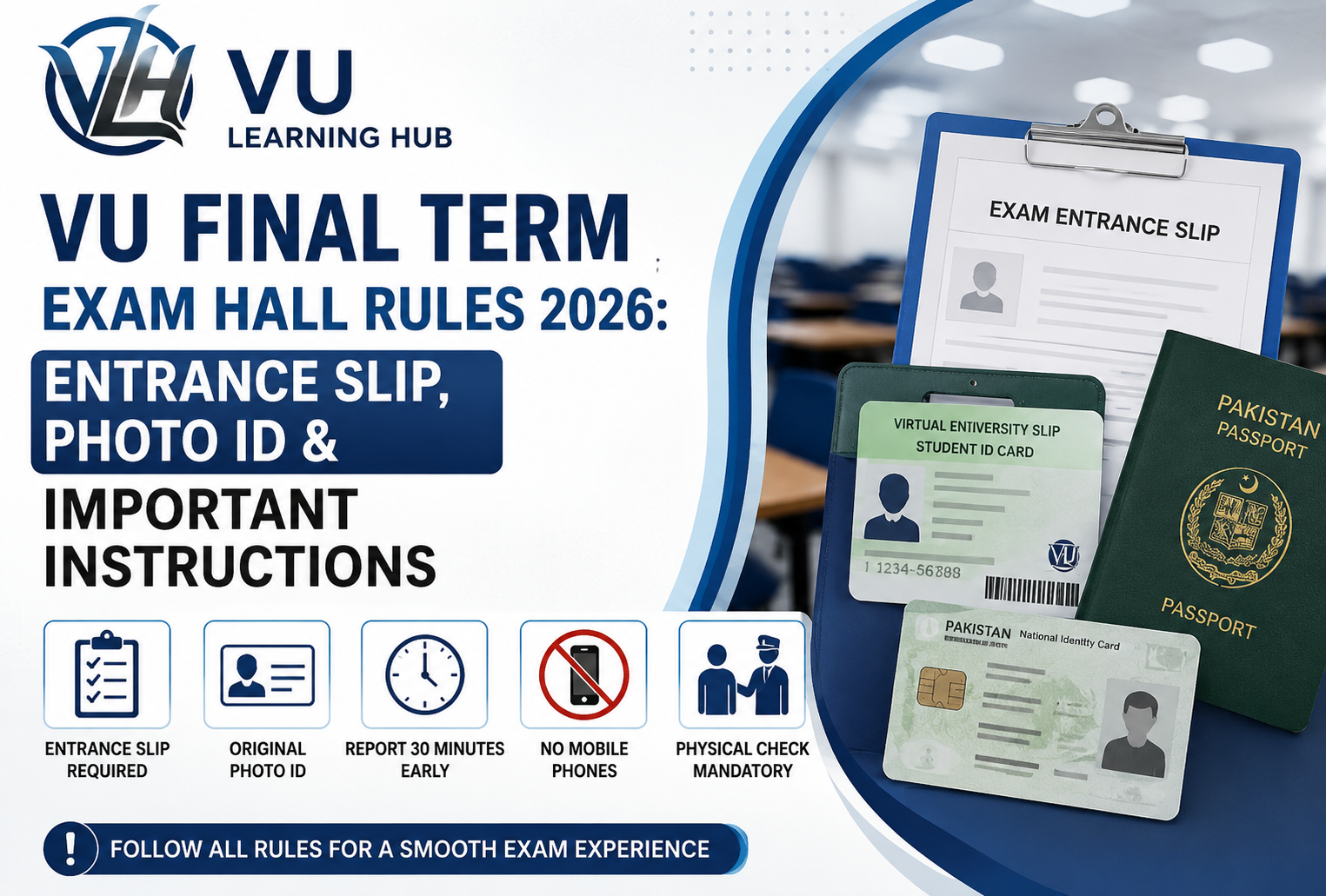
Every Virtual University student knows that exam day comes with its own set of nerves. You have studied the whole semester, revised your notes, and maybe even gone through a few past papers the night before. But there is one thing that can ruin your exam day faster than a tough question paper: forgetting your Exam Entrance Slip or your original photo ID.
VU takes exam hall entry rules seriously, and for good reason. These rules protect the fairness of the examination process for every student sitting in that hall. If you show up without the right documents, you simply will not be allowed inside, no matter how well prepared you are. This guide walks you through everything you need to know about the VU Exam Entrance Slip, accepted ID documents, reporting times, prohibited items, and the dress code, so you can walk into your exam center with full confidence and zero last minute panic.
What Is the VU Exam Entrance Slip and Why It Matters
The Exam Entrance Slip is your official permission document to sit in a Virtual University examination. Think of it as your ticket into the exam hall. Without it, the invigilation staff at your exam center will not let you take your seat, even if your name appears in the class list. VU issues this slip to every registered student ahead of the exam schedule, and it usually contains your roll number, course details, exam center address, and paper timing.
Carrying this slip is not optional. It works together with your original photo ID to confirm your identity and confirm that you are registered for that specific paper at that specific center. Many students assume a screenshot on their phone is good enough. It is not. VU exam staff generally expect a printed copy, since mobile phones are not allowed inside the hall in the first place. This is one of the most common and completely avoidable mistakes students make before finals.
If you are unsure how to access or print your slip, it is worth checking your assignment and exam preparation resources on VULearningHub well before exam week. Waiting until the night before your paper to sort out printing issues adds unnecessary stress to an already demanding season. Treat the entrance slip with the same seriousness as your actual exam preparation, because without it, all that preparation goes to waste at the door.
Documents You Must Carry to the VU Examination Hall
Along with your Exam Entrance Slip, VU requires an original photo ID for entry. This is a strict identity verification step, and photocopies or digital images are not accepted. The accepted documents include your VU ID Card, CNIC, Passport, Domicile certificate, or a Driving License. You only need one of these, but it must be the original and it must clearly show your photograph.
Students sometimes lose their VU ID Card or let it expire without realizing it. If that happens to you, do not panic and do not skip the exam. Your CNIC works just as well for verification purposes, and most students already carry it in their wallet. International students or those without a CNIC can rely on their passport instead. The key point is that the name and photo on your ID must match the details on your Exam Entrance Slip.
It helps to prepare both documents a day or two in advance rather than searching for them on the morning of your paper. Keep them in one place, maybe alongside your stationery or exam bag essentials, so there is no last minute scrambling. If you are also preparing your notes and revising through VU study guides and quiz material, set aside five minutes to double check that your ID and slip are ready too. Small preparation steps like this prevent big problems later.
VU Exam Reporting Time: Why Reaching Early Matters
Virtual University asks students to report at the exam center 30 minutes before their paper begins. This is not a suggestion, it is a firm requirement built into the exam conduct policy. Reaching early gives you time to complete identity checks, find your designated seat, and settle your nerves before the paper starts.
Exam centers can get crowded, especially during regular semester exams when hundreds of students from different programs sit at the same location. If you arrive right at the starting time, you may end up standing in a queue for identity verification while your paper clock is already running. That is a stressful way to begin any exam, and it eats into time you could have spent answering questions.
Reaching early also gives you a mental buffer. You can locate your seat, adjust to the room environment, and take a few calm breaths before the invigilator distributes the question paper. Students who rush in at the last minute often report feeling flustered, which affects their performance in the first few minutes of the exam. Since VU exams are often time bound and sometimes MCQ based with strict per question timers, starting calm matters more than people realize. Treat the 30 minute rule as part of your exam strategy, not just an administrative formality. Pair this habit with proper revision using VU exam preparation notes so both your timing and your content knowledge are on point.
What Happens If You Are Late for Your VU Paper
VU has a clear cutoff for late arrivals. If you arrive more than 15 minutes after your paper has started, you will be marked absent. There is no partial credit or special consideration for this rule. It applies uniformly across exam centers, and invigilators are instructed to follow it strictly.
This rule exists because VU exams, particularly quizzes and finals, run on tight schedules across the country. Allowing flexible entry times would disrupt the fairness of the exam for other students and complicate the overall exam conduct process. A 15 minute grace period is already generous compared to many other examination systems, so it is meant to cover minor delays like traffic or last minute document checks, not casual lateness.
If something genuinely unexpected happens, such as a medical emergency or a serious transport issue, your best option is to contact VU directly through the official conduct email as soon as possible, rather than assuming you can explain it at the center door. Being marked absent for a paper can affect your GPA and may require you to repeat the course in a later semester, so it is not a risk worth taking. Planning your route to the exam center a day in advance, especially if it is unfamiliar, removes a big chunk of this risk entirely.
Items Not Allowed Inside the VU Examination Hall
Mobile phones, electronic devices, and bags are strictly prohibited inside VU examination halls. This includes smartwatches, calculators unless specifically permitted for your course, USB drives, and any device capable of storing or transmitting information. VU is explicit that it holds no responsibility for the security or loss of these prohibited items if you bring them anyway.
This means you should not expect a safe storage area at the exam center. Some centers may offer informal drop off points, but this is not guaranteed, and VU will not compensate you if something goes missing. The safest approach is to leave unnecessary electronics and bags at home or in your vehicle before you even enter the center premises.
If a prohibited item is found on you during the exam, the consequences are severe. The item will be confiscated on the spot, and your paper will be canceled immediately, regardless of how much of it you had already completed. This is one of the strictest rules in the VU exam conduct policy, and it exists to prevent any possibility of cheating or unauthorized communication during the paper. Bring only what you truly need, such as your entrance slip, ID, and basic stationery like pens. Anything else is simply not worth the risk.
Security Checks Before Entering the Exam Hall
Every student is physically checked before entering the VU examination hall. This is a standard security procedure, not something to feel singled out about. Staff conduct these checks to ensure no prohibited items, including small electronic devices or written material, make it inside undetected.
The check is usually quick if you have already left electronics and bags outside. Wearing simple, practical clothing without excessive pockets, layers, or accessories can also make the process faster and more comfortable for you. Female and male students are typically checked separately by staff of the same gender, following standard exam center protocol across VU centers nationwide.
It helps to arrive mentally prepared for this step rather than being caught off guard. Some students feel anxious about physical checks, but understanding that it is routine for everyone in the hall can ease that discomfort. Cooperating calmly and having your documents ready in hand speeds things up considerably. Combine this with early reporting, and you will move through security without eating into your actual exam time. This is another reason why the 30 minute early arrival rule matters so much, since rushing through a security check adds avoidable stress right before you need to focus.
Dress Code Guidelines for VU Exams
Virtual University requires students to come in proper dress for exams, and shorts are explicitly not allowed. While VU does not enforce a rigid uniform, it expects modest and appropriate clothing suitable for a formal academic setting. This applies to all students regardless of gender or exam center location.
Dressing appropriately is not just about following a rule. It reflects the professional standard VU maintains for its examination process, similar to how you would dress for a university campus visit or a formal test center anywhere else. Comfortable, simple clothing also helps you focus better during the exam itself, rather than worrying about being asked to adjust your attire at the entrance.
If you are ever unsure what counts as appropriate, a safe rule of thumb is to dress the way you would for an in person university lecture or a formal interview. Avoid overly casual beachwear, sleeveless outfits in conservative settings, or anything that might draw unnecessary attention from center staff. This small detail is easy to overlook when you are focused on studying, but it can cause real delays or discomfort at the entrance if ignored. Pair sensible clothing with your entrance slip and ID, and you remove one more variable from your exam day checklist.
How to Avoid Last Minute Entrance Slip and ID Problems
Most exam hall issues at VU are completely preventable with a little planning. Start by confirming your exam center location and paper timing at least two to three days before your exam through your official VU portal. Print your Exam Entrance Slip early rather than waiting until the morning of the paper, since printer or internet issues can happen at the worst possible time.
Next, physically locate your original ID document, whether that is your VU ID Card, CNIC, Passport, Domicile, or Driving License, and keep it in a fixed place you will not forget. Many students keep a small folder or envelope specifically for exam documents during finals week. This single habit prevents the common last minute search through drawers and bags on exam morning.
It is also worth reviewing your subject material one more time using structured VU quiz and assignment guides, since walking in prepared academically reduces overall exam anxiety, which in turn makes the entire entry process feel less overwhelming. Students who feel confident about their content tend to handle administrative steps like document checks and security screening with far more patience. Preparation is not just about studying, it is about managing the entire exam day experience so nothing catches you off guard.
Common Mistakes Students Make Before VU Exams
Even well prepared students slip up on small details that have nothing to do with academic knowledge. One frequent mistake is bringing an expired or damaged VU ID Card and assuming it will still work at the entrance. Always check that your ID is valid and clearly readable before exam day.
Another common error is underestimating traffic or travel time to an unfamiliar exam center, leading to a late arrival that results in being marked absent. If your exam center has changed from a previous semester, take time to map the route beforehand rather than assuming it is the same location. Similarly, some students bring bags out of habit without thinking about VU's strict no bag policy, only to face confusion and delay at the entrance point.
A less obvious mistake is not reading the exam conduct instructions at all, both the English and Urdu versions VU provides. These instructions cover exactly the rules discussed in this guide, and ignoring them because they seem like standard boilerplate text is a mistake many students regret. Taking ten minutes to read through official VU communication before your exam can save you from avoidable stress on the actual day.
Frequently Asked Questions
Can I use a photocopy of my CNIC instead of the original?
No. VU requires the original photo ID. Photocopies, scanned images, or digital copies on your phone are not accepted for entry verification.
What if I forget my Exam Entrance Slip but have my ID card?
You should not rely on this. Both documents are required together. Always print and carry your entrance slip separately from your ID.
Are calculators allowed inside the exam hall?
Only if your specific course and paper instructions permit it. Otherwise, calculators fall under the general restriction on electronic devices.
Who do I contact if I have a query about exam rules?
You can send your query directly to VU at conduct@vu.edu.pk for official clarification on any exam conduct matter.
Final Thoughts
Passing your VU exams starts long before you open the question paper. It starts with having the right documents, arriving on time, dressing appropriately, and understanding exactly what is and is not allowed inside the examination hall. These rules might feel strict, but they exist to protect every student's chance at a fair and smooth exam experience.
Take a few minutes today to check your Exam Entrance Slip status, confirm your ID is valid, and review your exam center location. Combine that preparation with solid academic revision through VULearningHub's study resources, and you will walk into your exam center fully ready, both on paper and in person.