The wait is finally over. VU final term exams are starting from 27 July, and thousands of Virtual University students across Pakistan are getting ready for this crucial phase of the semester. Whether you have been preparing for weeks or you are still revising your notes at the last minute, this is the moment where your hard work gets tested. Final term exams carry the biggest weight in your overall grade, so understanding how the process works and how to prepare smartly can make a real difference in your result.
At VULearningHub, we know how stressful this period can be for VU students. That is why we bring you updated study material, past papers, quizzes, and assignment help all in one place. But there is something even more valuable during exam season: real paper reviews shared by students who just gave their exam. In this guide, we will walk you through everything about the VU final term exam schedule, how to prepare effectively, and why sharing and reading paper reviews on VULearningHub can genuinely improve your exam performance.
VU Final Term Exam Schedule: What You Need to Know
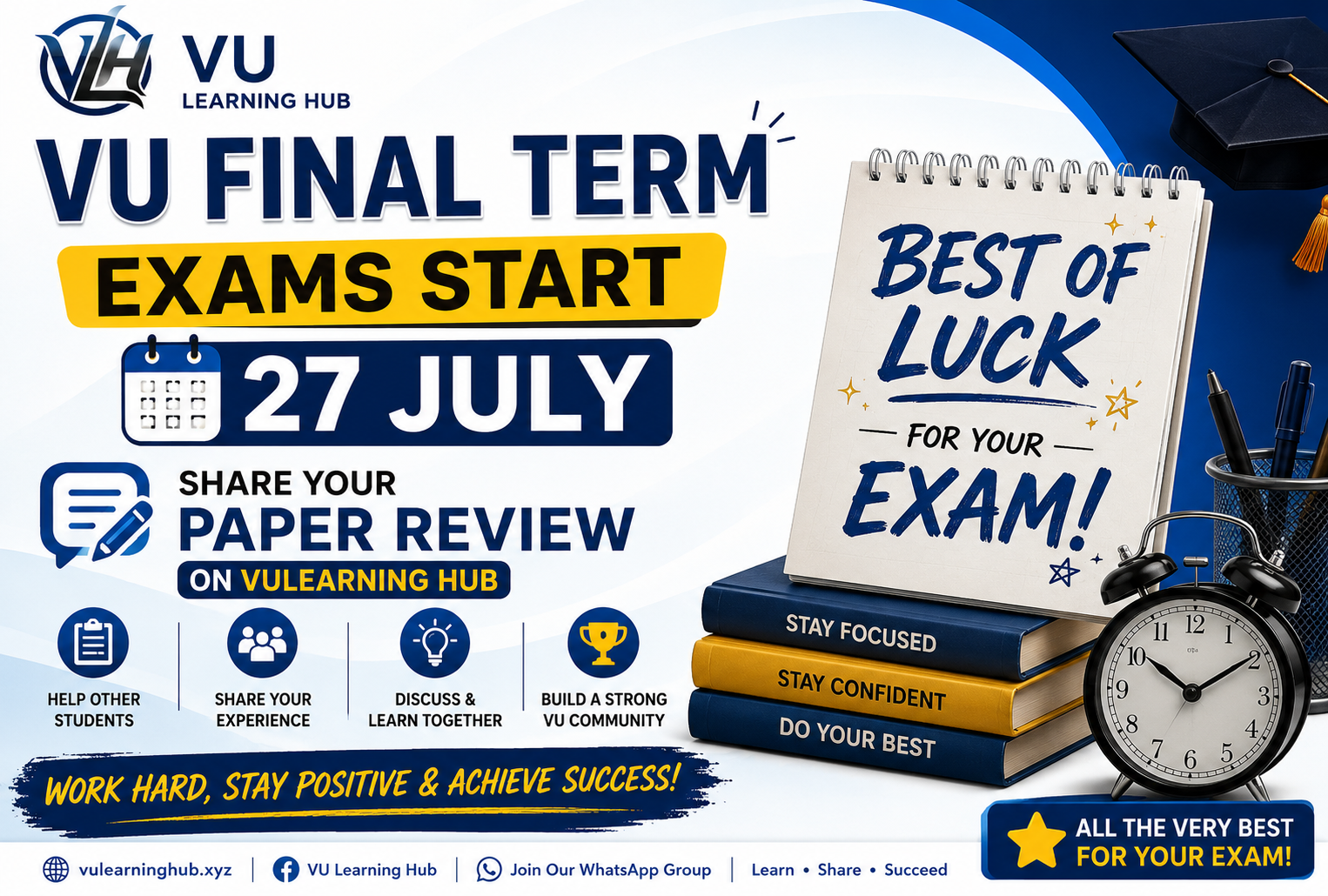
Virtual University follows a semester system, and the final term exam marks the end of each academic term. This year, the final term exams officially begin on 27 July and will continue for several days depending on your course load and exam slots. Every student receives a personalized exam schedule through their VULMS account, showing exact dates, timings, and the format of each paper.
It is important to check your schedule early rather than waiting until the last day. Many students accidentally miss their exam slot simply because they did not confirm the timing in advance. Log into VULMS regularly during this period since VU sometimes updates timings or adds instructions closer to the exam date. Keep a printed or saved copy of your schedule so you are never caught off guard.
Final term exams at VU are usually conducted online through the LMS system, and papers may include multiple choice questions, short questions, and long questions depending on the subject. Some courses also include case studies or numerical problems, especially in business and computer science subjects. Knowing the format of your paper in advance helps you plan your revision strategy accordingly.
Since the exam window is limited, time management becomes critical. Students who plan their exam days properly, without cramming everything into the last 24 hours, tend to perform noticeably better. Treat your final term like a project with a deadline rather than a single overwhelming event.
Why Paper Reviews Matter More Than You Think
One of the most underrated exam preparation tools is reading paper reviews shared by other students. A paper review is simply a summary of the questions that appeared in someone's exam, written right after they finish their paper. Since VU conducts exams in different time slots and sometimes different question sets for the same course, these reviews give you a realistic idea of what to expect.
Paper reviews are not about leaking exam content unfairly. They are about understanding the pattern, difficulty level, and topic focus of a subject's final term paper. If several students report that a particular chapter appeared repeatedly, it tells you where to focus your remaining preparation time. This kind of real feedback from peers is something no official study guide can fully replace.
This is exactly why VULearningHub created a dedicated space for students to share their paper reviews right after their exam. You can visit the live paper reviews page to see what other students experienced in their recent exams. It is updated continuously as students post their reviews, so checking it a few hours before your own paper can give you a genuine advantage.
Reading these reviews also helps reduce exam anxiety. When you know roughly what kind of questions to expect, walking into your exam feels less intimidating. You stop worrying about the unknown and instead focus on applying what you already know.
How to Share Your Own Paper Review Effectively
Once you finish your final term paper, take a few minutes to share your experience on VULearningHub. This small act of sharing directly helps hundreds of other students who have the same course scheduled in a later slot. A good paper review does not need to be long or perfectly written. It just needs to be honest and clear.
Start by mentioning the course code and the total number of questions in your paper. Then briefly describe the type of questions you faced, such as whether they were conceptual, numerical, or based on case studies. If you remember specific topics or chapters that were heavily tested, mention them clearly. Avoid writing entire questions word for word since paraphrasing the topic area is usually more useful and appropriate.
It also helps to mention the difficulty level compared to your expectations. Was the paper easier than the past papers you practiced, or was it tougher with unexpected topics? This kind of context helps other students calibrate their own preparation. If your paper included a mix of MCQs and short questions, note the approximate ratio, since this detail changes how someone should divide their revision time.
Sharing a review takes less than five minutes but its impact lasts for the entire exam week. Many VU students specifically visit the live paper review section before their own exam slot just to read the latest updates from students who attempted the same paper earlier that day. When you contribute your review, you become part of a support system that makes final term exams a little less stressful for everyone involved.
Smart Preparation Tips Before Your Exam Day
Good preparation is not just about reading handouts repeatedly. It is about using the right combination of resources at the right time. Start by reviewing your handouts alongside VU past papers, since VU often repeats question patterns across semesters even when the exact wording changes. Past papers give you a realistic sense of how questions are framed and what level of detail is expected in your answers.
Alongside past papers, make use of short quizzes to test your memory of key concepts. Quizzes are especially useful for subjects with heavy theory content, since they force you to recall definitions and terminology quickly rather than just recognizing them. If you struggle with a particular topic during a quiz, that is a clear signal to revisit your notes before exam day.
Group study, even in an online format, can also boost your understanding significantly. Discussing tricky concepts with classmates through WhatsApp groups or study forums often clears up confusion faster than studying alone. However, be selective about your study group. A focused group of two or three serious students is usually more productive than a large group full of distractions.
On the night before your exam, avoid trying to learn new topics. Instead, spend your time reviewing summaries, formulas, and key definitions you have already studied. Get proper sleep, since exhaustion affects memory recall far more than most students realize. A calm and rested mind performs better under exam pressure than a tired one filled with last minute cramming.
Common Mistakes VU Students Make During Final Term
Every semester, a similar pattern of mistakes repeats itself among VU students during final term exams. Recognizing these mistakes early can help you avoid them completely. The first common mistake is not checking the exam schedule carefully. Students sometimes assume their exam timing based on the previous semester's pattern and end up missing their actual slot.
Another frequent issue is poor time management during the exam itself. Some students spend too much time on the first few questions and then rush through the remaining paper, which affects the quality of their answers. It is better to quickly scan the entire paper first, then allocate time based on the marks assigned to each question. This simple strategy prevents unnecessary panic in the final minutes.
Many students also rely entirely on past papers without properly understanding the underlying concepts. While past papers are extremely useful, VU occasionally introduces new questions or changes the phrasing significantly. If you only memorize answers without understanding the logic, an unexpected question can catch you off guard. A better approach is using past papers to identify important topics, then studying those topics thoroughly rather than memorizing fixed answers.
Technical issues are another overlooked problem. Weak internet connections, browser glitches, or last minute login problems have caused real trouble for students in the past. Always test your internet connection and login credentials well before your exam slot begins, ideally the day before. Keep a backup internet option ready, such as mobile data, in case your primary connection fails during the exam.
Using VULearningHub Resources to Boost Your Score
VULearningHub is built specifically to support VU students through every stage of their academic journey, and final term exams are no exception. Beyond the live paper review section, the platform offers organized study guides that break down complex handout content into simpler, easy to understand explanations. This is particularly helpful for subjects that involve heavy theoretical material or technical jargon.
The platform also maintains a collection of solved past papers and practice quizzes tailored to VU's course structure. Instead of searching multiple websites for scattered material, students can find relevant resources organized by course code, which saves valuable preparation time during the busy final term period. This organized approach means less time searching and more time actually studying.
During the exam period specifically, checking the live paper review page regularly gives you a real time pulse on what is happening across different exam slots. Since VU conducts exams over multiple days for many courses, reviews posted by morning slot students can genuinely help those attempting the same paper in an afternoon or evening slot. This kind of community driven support is something VULearningHub actively encourages among its student users.
If you are unsure where to start, prioritize checking your weakest subjects first. Use the study guides to strengthen your conceptual understanding, then move to past papers and quizzes for practice. Finally, before each individual exam, check the live paper review section for that specific course to see if any fresh insights have already been shared by earlier test takers that day.
Staying Calm and Confident Throughout Exam Week
Final term exam week can feel overwhelming, especially when you have multiple papers scheduled close together. Managing your mental and physical energy during this period is just as important as academic preparation. Students who maintain a steady routine throughout exam week generally perform more consistently across all their papers compared to those who push themselves to exhaustion.
Try to maintain a fixed sleep schedule even during exam days, since irregular sleep patterns directly affect concentration and memory recall. Eating light, balanced meals before your exam also helps maintain focus, as heavy meals can make you feel sluggish during a timed test. Taking short breaks between study sessions, even just a five minute walk or stretch, can refresh your mind significantly.
It also helps to avoid comparing your preparation level with other students, especially through social media or group chats filled with panic messages. Every student has a different pace and study method, and constant comparison usually increases anxiety without adding any real value to your preparation. Instead, focus on your own schedule and trust the effort you have already put in.
If you feel anxious before a particular exam, remind yourself that a single paper does not define your entire academic journey. Approach each exam with a clear mind, read every question carefully before answering, and manage your time wisely within the paper itself. Confidence built through consistent preparation, rather than last minute panic, is what genuinely leads to better results during VU final term exams.
Final Thoughts
VU final term exams starting from 27 July mark an important milestone in your semester, and how you approach the next few days can genuinely shape your overall result. Beyond textbooks and handouts, real support from fellow students often makes the biggest difference during this stressful period. Sharing your paper review after each exam takes only a few minutes, yet it becomes a valuable resource for classmates attempting the same paper later.
Make it a habit to check the live paper review section on VULearningHub before every exam and contribute your own review right after finishing. Combine this with consistent use of past papers, quizzes, and study guides, and you will walk into your final term exams far more prepared and confident than relying on any single resource alone. Good luck with your exams, and remember that steady, honest preparation always outperforms last minute panic.
Frequently Asked Questions
When do VU final term exams start this semester?
VU final term exams are scheduled to start from 27 July. Exact dates and timings vary by course and are visible in each student's personalized schedule on VULMS.
How can I share my paper review on VULearningHub?
After finishing your exam, visit the live paper review page and submit a short summary of your paper, including the question pattern, difficulty level, and any important topics covered.
Are paper reviews the same as leaked exam content?
No. Paper reviews are general summaries of question patterns and topics shared after a student finishes their exam. They are meant to guide preparation, not provide exact answers in advance.
What should I do if I face technical issues during my VU exam?
Test your internet connection and LMS login well before your exam slot. If issues occur during the exam, contact VU support immediately and keep a backup internet option ready such as mobile data.