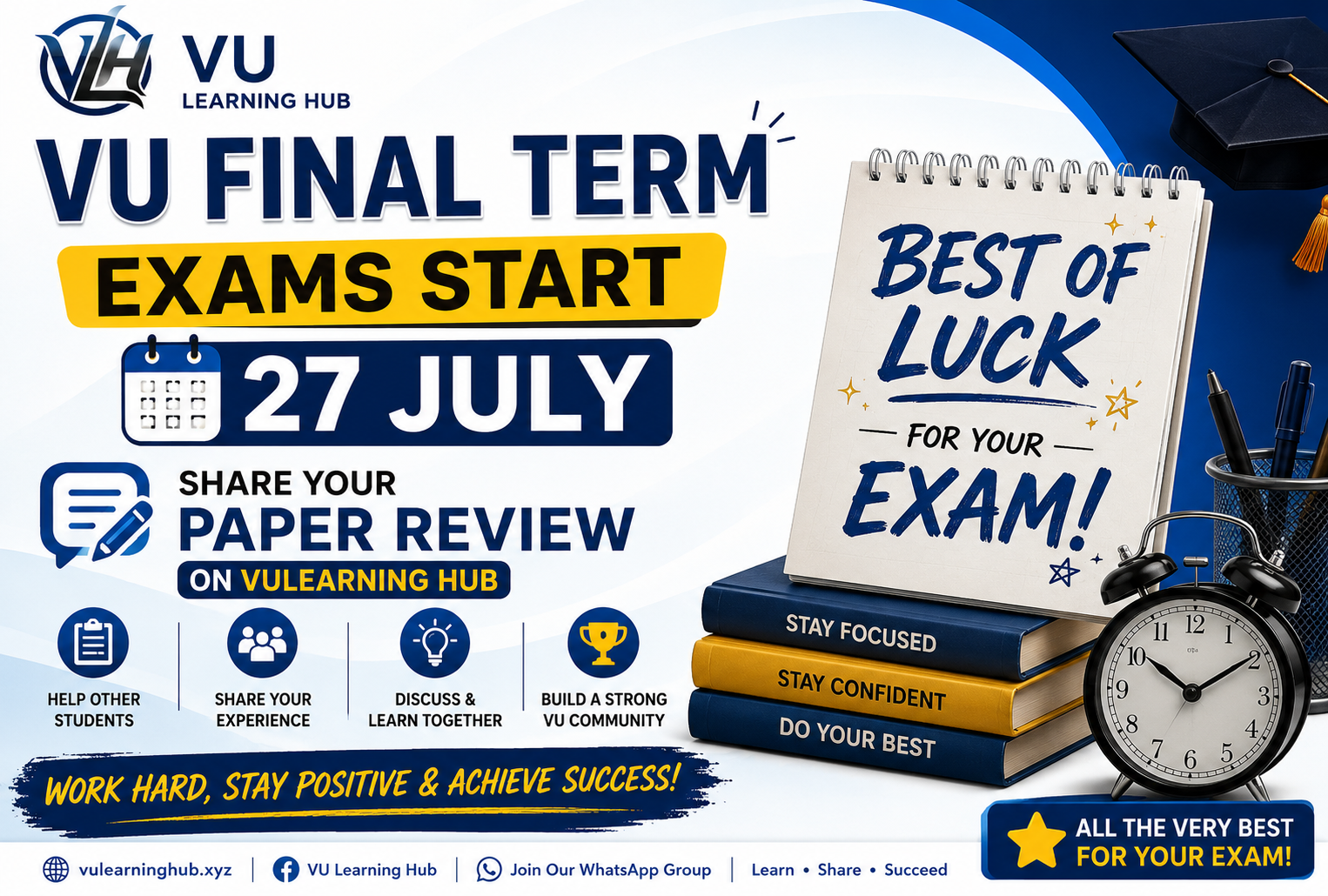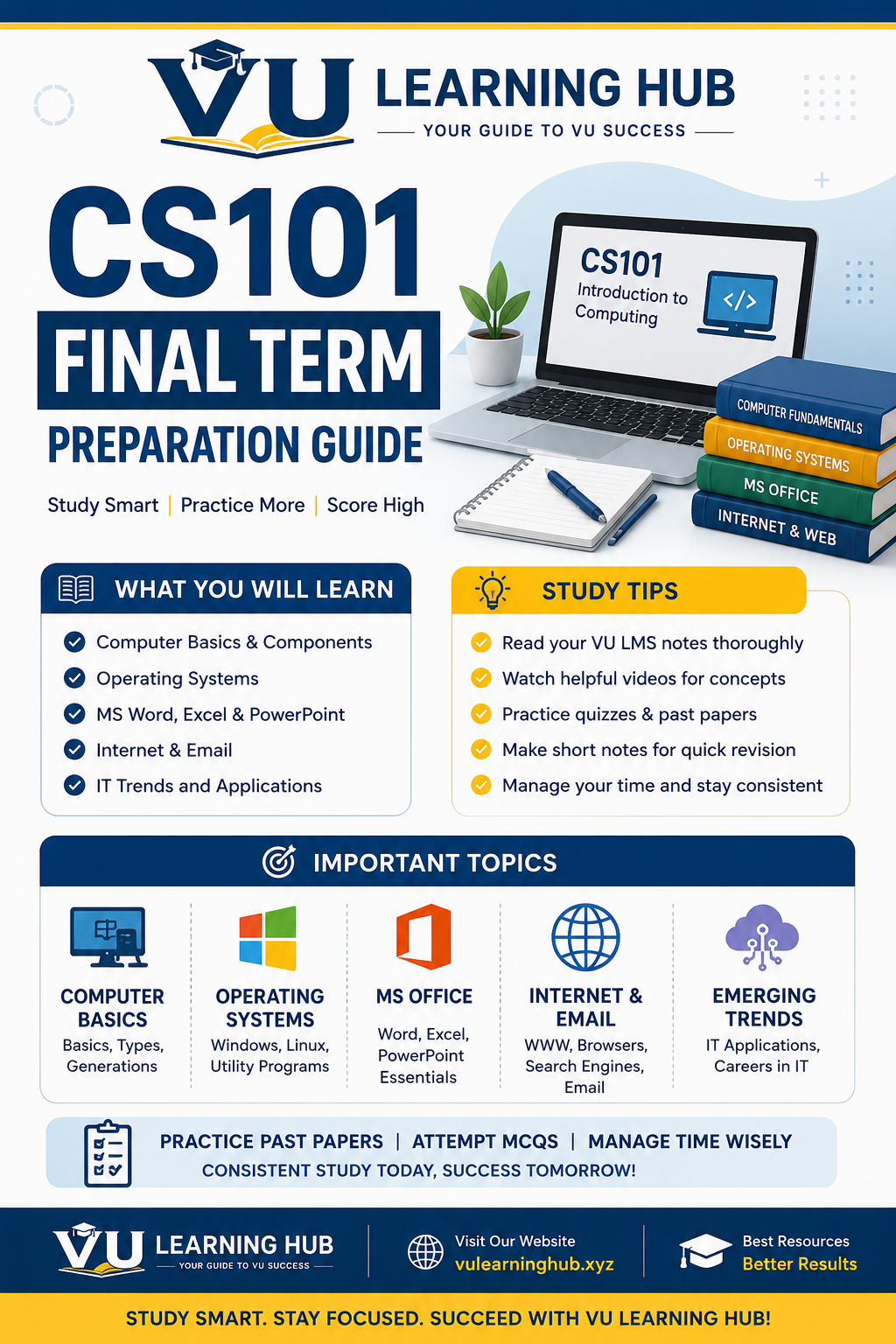
If you are enrolled in CS101 this semester, you already know the final term exams are starting from 27 July. That date might feel far away right now, or it might feel like it is rushing toward you faster than you expected. Either way, the biggest mistake most Virtual University students make at this stage is waiting too long to build an actual plan. CS101 introduces you to the basics of computer science, and while the earlier part of the course felt light, the final term portion actually covers far more ground than midterm did, so treating it casually is a costly mistake.
This guide breaks down exactly how to prepare for your CS101 final term exam with a realistic study schedule, the exact topic range you need to cover, and practical tips that actually work for VU students juggling jobs, families, and other courses. You will not find vague advice here. Everything in this post is built around the official CS101 paper pattern, the confirmed topic range for final term, and how you can use the resources already available to you on VULMS and on platforms like VU Learning HUB to save time.
Whether you are aiming for a high score or simply trying to clear the paper comfortably, the approach is the same. You need a clear timeline, a solid grasp of every topic from where midterm left off, enough MCQ practice, and a revision strategy that does not leave you cramming everything the night before the exam. Let us get into the details.
The Official CS101 Final Term Paper Pattern
Before you open a single handout, it helps to know exactly what the CS101 final term paper looks like, since VU has already released the official pattern for this term. The midterm exam covered topic 01 to topic 81, which is everything taught in the first six weeks of the course, and consisted of 40 MCQs to be solved in 50 minutes. The final term exam is different in scale. It covers everything from topic 82 onward, right through to the end of the course, and consists of 60 MCQs to be completed in 90 minutes.
This confirms two important things. First, the final term paper is entirely MCQ based, just like midterm, so you do not need to prepare any subjective or long answer questions. Second, and this is the part students often get wrong, final term does not repeat the topics you were already tested on in midterm. Everything from topic 01 to topic 81 is done. Your entire focus for this paper needs to go into topic 82 and everything that comes after it.
The reason this matters so much is that the post-midterm portion of CS101 is actually larger and more varied than the first half. It includes the remaining networking and security topics, the full algorithms section, programming language concepts, software engineering, data abstraction, database systems, artificial intelligence, the CS impact and ethics topics, and then a large practical section covering MS Word, MS PowerPoint, MS Excel, MS Access, and basic web page development. Treating this as a light revision task because you already passed midterm is exactly the mindset that catches students off guard.
With 60 MCQs in 90 minutes, you get an average of a minute and a half per question, which is a comfortable pace if your concepts are clear, but tight if you are trying to recall vague, half-understood material during the exam. You can compare this pattern against previous semesters using the past papers section of VU Learning HUB, sorted specifically for CS101 final term, to see how closely the actual paper matches this official structure.
Your Study Plan From Now Until 27 July
A study plan only works if it matches both the number of days you have left and the actual amount of content you need to cover, and for CS101 final term that content range is wide. Since your syllabus starts from topic 82 and runs through the end of the course, count the days between today and 27 July and divide that range into three phases rather than trying to read everything in one continuous pass.
The first phase, roughly the first half of your remaining time, should be spent going through the handout from topic 82 onward in order, section by section. Move through the remaining networking and security topics first, then algorithms, then programming languages, then software engineering. Do not try to memorize anything in this phase. Your goal is simply to understand what each topic is explaining, especially since several of these areas build on each other, and skipping ahead without understanding the basics of algorithms will make the programming languages section harder to follow.
The second phase should cover data abstraction, database systems, artificial intelligence, and the CS impact and ethics topics, followed immediately by MCQ practice on everything you have covered so far. This is also when you should start on the practical section covering MS Word, PowerPoint, Excel, Access, and web page development, since these topics are usually easier to remember through recognition rather than heavy reading, especially if you have used these applications before.
The final phase, the last two or three days before 27 July, should be pure revision across the entire topic 82 to end-of-course range. No new material at this stage. Go through your notes, attempt a few complete 60 question MCQ sets under timed conditions, and check the live papers section where students who have already appeared in their CS101 paper this term share the exact questions they faced. Since the final term syllabus is confirmed and fixed, this live feedback becomes extremely useful for spotting which topics within the range are actually being emphasized.
The Topic Areas That Make Up Your Final Term Syllabus
Since your final term syllabus runs from topic 82 to the end of the course, it helps to break it down into manageable blocks rather than treating it as one giant mass of content. The first block wraps up networking and the internet, covering protection and cures, encryption, and the legal approaches to network security. This picks up exactly where midterm left off, so if you remember the earlier networking topics well, this section will feel familiar and quick to revise.
The second and largest conceptual block is algorithms, running from the informal definition of an algorithm through pseudocode representation, iterative structures, sorting, the binary search technique, recursive control, algorithm efficiency, and software verification. This section rewards understanding over memorization, since MCQs here often test whether you can trace through a loop or identify what a simple algorithm outputs rather than asking you to recall a definition word for word.
Programming languages comes next, covering the generations of languages, imperative and declarative paradigms, variables and data types, control structures like if statements and loops, and the arithmetic, relational, and logical operators. This flows directly into software engineering, which covers the software life cycle, the different development phases, coupling and cohesion, design patterns, quality assurance, and documentation. Data abstraction follows with arrays, lists, stacks, queues, trees, and pointers, which are foundational concepts that also support the database systems section right after it.
Database systems is a substantial block on its own, covering schemas, relational models, the select, project, and join operations, database integrity, locking, and different file organization methods including sequential, indexed, and hash files. Artificial intelligence follows with intelligent agents, research methodologies, the Turing test, and language processing, and then the CS impact block covers ethics, privacy, security, intellectual property, and social issues related to technology.
The final and very practical portion of your syllabus covers MS Word, MS PowerPoint, MS Excel, MS Access, and basic web page development using Notepad and Dreamweaver. These topics are usually the easiest to score well on if you have hands-on familiarity with these tools, since MCQs here typically ask about specific ribbon groups, functions, or features rather than abstract concepts. For a faster way to move through this wide topic range without rereading every single handout page, the curated notes section offers condensed material organized to help you revise each block efficiently before your exam.
How to Use Past Papers the Right Way
Simply downloading a bundle of past papers and skimming through the answers is one of the most common mistakes VU students make. Past papers are a tool, not a shortcut, and how you use them determines how much benefit you actually get from them, especially now that you know the final term paper is fixed at 60 MCQs covering topic 82 onward.
Start by attempting a past MCQ paper without looking at the solved answers first, and set a 90 minute timer to mimic the real exam experience. This shows you exactly how your pace holds up across a full length paper and which topic blocks need more attention. Once you finish, compare your answers to the solved version, and for every question you got wrong, go back to the relevant section of the handout immediately rather than just memorizing the correct option in isolation.
After going through three or four past papers this way, you will start noticing that certain MCQs repeat across semesters with only minor wording changes, particularly within the algorithms, database systems, and software engineering blocks. Recognizing these repeated patterns lets you prioritize your remaining revision time on the topics that are statistically more likely to appear in your own paper. It also helps to attempt papers solved by different contributors, since each one may highlight slightly different important questions based on their own exam experience, and cross checking multiple versions gives you a fuller picture of what tends to get tested most often.
Common Mistakes Students Make While Preparing CS101
Even motivated students fall into a few predictable traps while preparing for CS101 final term. The first is assuming the final term syllabus is smaller or lighter than midterm simply because it comes second. In reality, the range from topic 82 to the end of the course covers more ground and more varied subject matter than the first 81 topics did, so underestimating the workload here is a common reason students run out of time before covering everything.
Another mistake is spending too much time re-reading midterm topics out of habit or nervousness. Since topics 01 to 81 are already covered and will not reappear on the final term paper, any time spent revisiting them is time taken away from the syllabus that actually matters for this exam. Stay disciplined and keep your focus strictly on topic 82 onward.
Some students also treat the practical MS Office and web development topics as an afterthought, assuming they are too easy to need dedicated revision time. While these topics are generally more approachable than algorithms or database systems, MCQs on specific ribbon features or menu options can still catch you off guard if you have not reviewed them recently. Give this section its own dedicated revision slot rather than leaving it for the very last minute.
Finally, some students prepare in isolation without checking what others are actually experiencing in their papers this term. Staying updated through shared experiences from students who have already appeared for CS101 can help you confirm which parts of the topic 82 onward range are being emphasized most heavily in the current semester's paper.
Time Management Tips During the Exam
Preparation does not stop once you walk into the exam. With 60 MCQs to complete in 90 minutes, you have roughly a minute and a half per question on average, which is enough time if you pace yourself deliberately. When the paper opens, resist the urge to rush through the first few questions. Read each one carefully, since MCQ options are sometimes designed to look similar with only a small but important difference between them.
Move through the paper at a steady pace and mark any question you are unsure about rather than getting stuck on it. Since the paper spans a wide range of topic blocks, from networking security through to web page development, it is common to feel very confident in some sections and less sure in others. Complete the questions you know well first to secure those marks, then return to the marked questions with whatever time remains.
If you are unsure between two options, use the elimination method by ruling out choices you know are incorrect based on your understanding of the topic. This is especially useful in the algorithms and database systems sections, where distractors often test a common misunderstanding rather than being random wrong answers. Keep an eye on the clock throughout, and aim to have your first pass through all 60 questions done with at least ten to fifteen minutes left for review.
Study Resources That Can Save You Time
You do not need to build every study resource from scratch, especially with a syllabus as wide as topic 82 through the end of the course and limited days remaining before 27 July. Official handouts remain your primary source, since final term MCQs are based directly on them, and you can access the latest updated versions through the official handouts section covering every VU course including CS101.
Alongside handouts, condensed notes prepared by students who have already scored well in similar courses can help you move through the wider final term range faster, especially once you reach the final revision phase and no longer have time to reread every section in full. These notes typically highlight the exact points examiners tend to focus on for MCQs across each topic block.
If you are someone who finds it hard to balance CS101 preparation with other ongoing coursework, assignments, or quizzes, it might also be worth exploring assistance for your other academic responsibilities so you can dedicate more focused time to a syllabus this size. VU Learning HUB's assignment solutions section offers reference material for other subjects, which can free up hours you would otherwise spend researching assignment content while your CS101 exam is approaching. For students consistently overwhelmed managing an entire semester's LMS activities alongside exam preparation, professional LMS handling services exist specifically to reduce that burden.
Frequently Asked Questions
What topics are included in the CS101 final term exam?
The final term syllabus covers topic 82 through the end of the course. This includes the remaining networking and security topics, algorithms, programming languages, software engineering, data abstraction, database systems, artificial intelligence, CS impact and ethics, and the practical section on MS Word, PowerPoint, Excel, Access, and web page development.
How many MCQs are in the CS101 final term paper and how long is it?
The CS101 final term exam consists of 60 MCQs to be completed in 90 minutes. This is a larger paper than midterm, which had 40 MCQs in 50 minutes and covered topic 01 to topic 81.
Do I need to revise midterm topics again for final term?
No, topics 01 to 81 were already tested in your midterm exam and do not repeat in the final term paper. Your final term preparation should focus entirely on topic 82 onward.
Final Thoughts Before Your CS101 Exam
CS101 final term does not have to feel overwhelming if you approach it with a clear plan instead of last minute panic. With exams starting from 27 July, and a confirmed syllabus running from topic 82 to the end of the course, you know exactly what to prepare for and exactly how the paper is structured, which is 60 MCQs in 90 minutes. Use that clarity to your advantage instead of second guessing what might be included.
Break your remaining days into focused blocks, work through each topic area from networking security through to web page development, and finish with real MCQ practice under timed conditions. Preparation done consistently over the next couple of weeks will always outperform a rushed, sleepless night before the exam. Good luck with your CS101 final term, and make sure to check back for updated live paper experiences as your exam date gets closer.