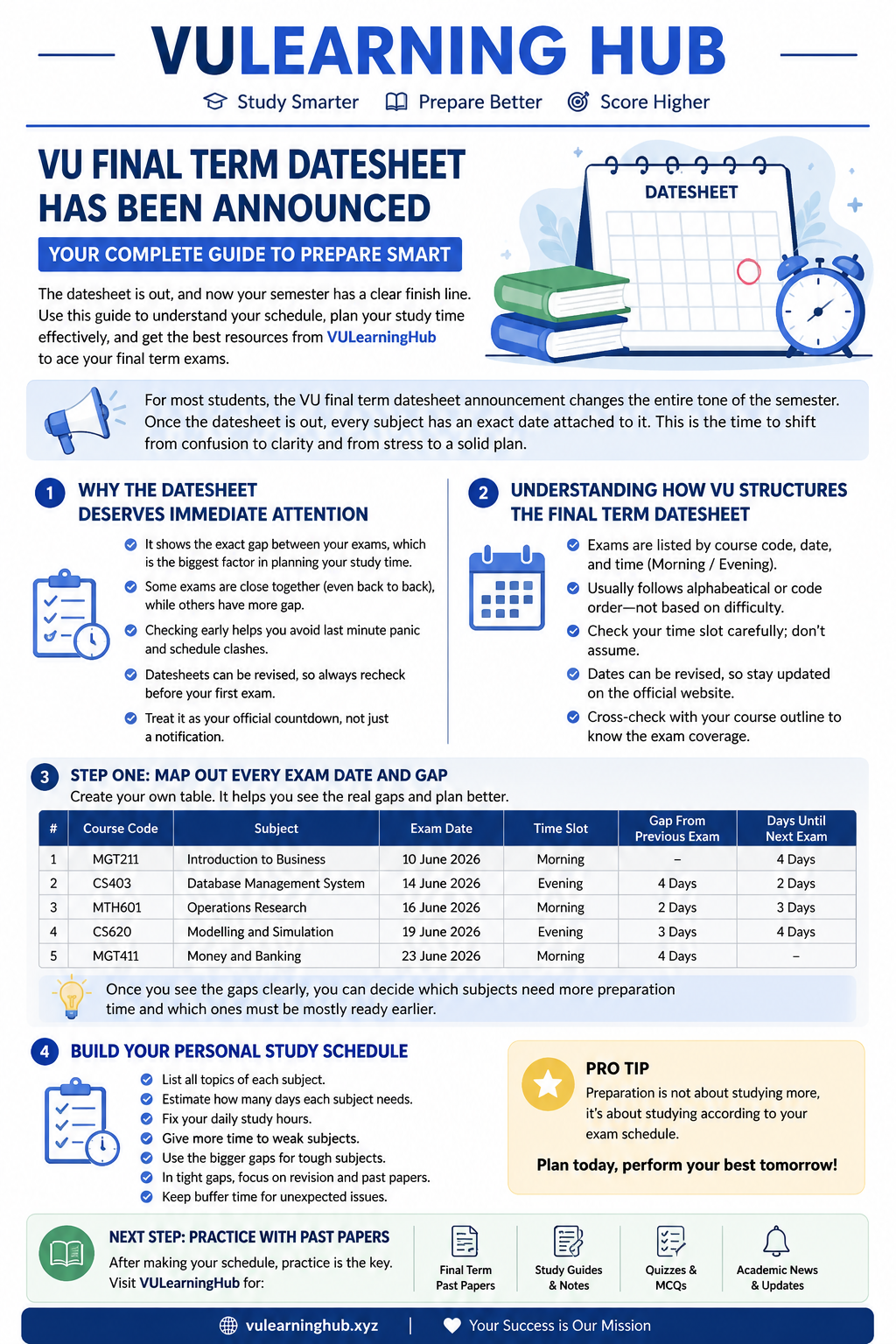
The VU final term datesheet has been announced, and for most students, that single announcement changes the entire tone of the semester. Everything before this point felt somewhat spread out, with lectures, quizzes, and assignments arriving on their own schedule. Once the datesheet is out, the semester suddenly has a hard finish line, and every subject you are studying now has an exact date attached to it. That shift from open ended preparation to a fixed countdown is exactly why so many students feel a mix of urgency and confusion the moment they open the official schedule.
This guide walks you through how to read your VU final term datesheet properly and, more importantly, how to turn that official document into your own personal exam schedule. The official datesheet tells you when each paper happens. It does not tell you how to prepare for five or six exams that might be spaced unevenly across a couple of weeks, some back to back and others days apart. Building your own study timetable around the official dates is what actually determines how those weeks go. Once your schedule is ready, VULearningHub's final term past papers archive is the natural next stop for turning that plan into real preparation.
Why the Datesheet Announcement Deserves Immediate Attention
It is tempting to see the datesheet notification, note the general timeframe, and go back to whatever you were doing before checking it properly later. This is one of the most common mistakes students make during final term, and it usually costs more time than it saves. The datesheet is not just a list of dates. It reveals the exact gap between your exams, and that gap is the single biggest factor in how you should be allocating your remaining study time across different subjects.
Some semesters bring exams spaced comfortably apart, giving you two or three full days between each paper. Other semesters compress several exams into a tighter window, sometimes with only a single day separating back to back subjects. You cannot know which situation you are dealing with until you actually sit down and map out the full datesheet, subject by subject, rather than skimming it once and trusting your memory of the general pattern. A student who assumes they have comfortable spacing, based on a quick glance, can end up seriously underprepared for a pair of exams that turn out to be only a day apart, simply because they did not verify the actual gaps early enough to adjust their study plan.
Beyond spacing, the datesheet also confirms exam timing and format details that matter for logistics, not just study planning. Confirming your exact time slots as soon as the datesheet is published avoids last minute scrambling, particularly if you have any overlapping personal or work commitments that need to be rearranged around specific exam dates. Treating the datesheet announcement as something worth genuine attention, rather than a quick notification to glance past, sets the tone for how organized the rest of your final term preparation turns out to be.
Understanding How VU Structures the Final Term Datesheet
Before building your own schedule, it helps to understand how VU typically organizes its final term datesheet, since this structure directly shapes how you should read it. Exams are usually listed by course code, exam date, and time slot, often split across a morning and evening session to accommodate the large number of students enrolled across different programs. Because VU serves students nationwide with vastly different daily schedules, having two sessions per day is common, and it is worth double checking which specific session your course falls into rather than assuming based on habit from a previous semester.
The datesheet also generally follows a rough alphabetical or code based sequence rather than an order tied to course difficulty or credit hours, which means you cannot assume the sequence itself carries any preparation priority. A challenging course might appear early in the schedule while an easier one falls near the end, so relying on the datesheet's natural order as your study order is not a reliable strategy. You need to actively rearrange your preparation priority based on your own strengths and weaknesses in each subject, not the order VU happens to list them in.
It is also worth noting that datesheets occasionally get revised after initial publication, particularly if scheduling conflicts arise across a large number of programs and campuses. Checking your datesheet again closer to your first exam, rather than relying solely on the version you saved weeks earlier, is a simple habit that prevents the rare but real risk of missing a paper due to an unnoticed date change. Cross referencing your official datesheet against your course outline can also help you confirm which portions of the syllabus each final exam is expected to cover.
Step One: Map Out Every Exam Date and Gap
The first real step in building your own schedule is transferring the official datesheet into a simple format you control, rather than working directly off the university's version every time you plan your day. A basic table works well here, listing each course code, its exam date, its time slot, and the number of days available before that exam and after the previous one. This single exercise often reveals patterns that are easy to miss when just scanning the original datesheet, such as two demanding subjects landing only a day apart in the middle of your exam sequence.
Once you can see the actual gaps clearly, identify which stretches give you the most preparation time and which ones are tightest. Exams with only a single day of gap before them need to be essentially ready well before that point, since you will not realistically be able to do serious new preparation for that subject the day before while still recovering from the exam that came right before it. Exams with three or four days of breathing room before them can absorb a slightly later start to focused preparation without the same level of risk.
This mapping exercise is also the right moment to flag any exams that fall on dates conflicting with personal responsibilities, work commitments, or anything else that might affect your availability to prepare properly. Spotting a conflict two or three weeks out gives you time to adjust your work schedule or arrange support elsewhere, while spotting the same conflict two days before the exam leaves you with very few good options. Treat this first mapping step as the foundation everything else in your personal schedule gets built on, since a plan built on an inaccurate or incomplete picture of your actual dates rarely holds up once the exam period actually begins.
Step Two: Rank Your Subjects by Preparation Need
With your exam dates and gaps mapped out, the next step is honestly ranking your subjects by how much preparation each one genuinely needs, rather than by how much you feel like studying them. This distinction matters more than it sounds. Many students naturally gravitate toward subjects they enjoy or already understand well, leaving the genuinely difficult ones for later simply because they are less comfortable to sit down with. During final term, that instinct works directly against you.
A useful way to rank fairly is to look back at your midterm result and your overall performance across quizzes and assignments for each course this semester. Subjects where you struggled earlier in the semester are very likely to need more preparation time now, since final term content in most VU courses builds on concepts introduced during the first half. If a foundational topic was already shaky at midterm, the final term content connected to it will not automatically become clearer just because more time has passed. Reviewing your midterm performance alongside this ranking exercise gives you a much more realistic picture than relying purely on how confident you currently feel about each subject.
Once ranked, match this list against the gaps you identified in the previous step. Subjects that need the most work should ideally land in the stretches of your schedule with the most available preparation time, not the tightest ones. If a high need subject unfortunately falls into a tight gap regardless of ranking, that tells you to start preparing for that specific exam earlier than the others, well before the general final term preparation period even begins, rather than waiting for its designated slot in your schedule to arrive naturally.
Step Three: Build a Realistic Daily Study Block
Once you know which subjects need the most attention and where the tightest gaps fall, the final step is translating all of this into an actual daily plan rather than a vague mental sense of what needs to happen. A realistic daily study block breaks your available time into subject specific sessions, ideally covering no more than two or three subjects in a single day during the lead up to exams, since spreading attention across too many subjects in one sitting tends to reduce how much actually sticks.
Be honest about how much study time you genuinely have each day, factoring in work, family responsibilities, and basic rest, rather than building an idealized schedule you know from experience you will not actually follow. A realistic plan you can stick to consistently produces far better results than an ambitious one that collapses after three days because it never accounted for how your actual routine works. If you are working alongside your studies, consider whether some of your recurring LMS tasks during this final stretch could be handled through support services, since VULearningHub's premium LMS services exist specifically to free up preparation time for students juggling exams with other demanding commitments.
Within each subject specific session, prioritize active preparation methods over passive rereading, particularly for subjects where your midterm performance flagged weaker understanding. Working through final term past papers for each course gives you a realistic sense of question patterns and difficulty, while reviewing highlighted notes helps you revise concepts quickly without wading through entire handouts again during a period when time is genuinely limited.
Using Past Papers to Prepare Smarter, Not Just Longer
Once your daily study blocks are set, how you actually spend that time matters just as much as how much time you allocated. Simply rereading handouts from start to finish is one of the least efficient ways to prepare for a final exam, particularly under time pressure, because it does not test whether you can actually apply what you are reviewing under exam conditions. This is exactly where past papers become genuinely valuable rather than optional extra practice.
Working through previous final term papers for each course shows you the actual format and difficulty level you are likely to face, rather than leaving you to guess based on handout content alone. Pay attention not just to which topics repeatedly appear across different semesters, but also to how questions are typically phrased, since VU exams often test the same underlying concept in slightly different wording from one term to the next. Recognizing a familiar concept dressed in unfamiliar phrasing is a skill that improves specifically through past paper practice, not through passive reading.
For subjects where you are already reasonably confident, past papers work well as a quick confirmation tool, letting you verify your understanding without spending excessive time on material you have already covered. For weaker subjects, treat past papers as a genuine diagnostic tool, working through them under timed conditions where possible to simulate actual exam pressure rather than casually browsing questions with no time constraint. This distinction in how you use the same resource, depending on your subject ranking from earlier, makes your limited preparation time noticeably more effective than treating every subject with the same generic approach.
Common Mistakes Students Make After the Datesheet Comes Out
A number of predictable mistakes tend to appear once the final term datesheet is announced, and being aware of them ahead of time makes them easier to avoid. The most common one is delaying serious preparation because the first exam still feels far away, only to realize with a week left that several subjects still need substantial work and the available time no longer matches what is actually required. The datesheet often creates a false sense of security early on, precisely because the overall timeframe looks generous until you break it down subject by subject.
Another frequent mistake is treating every subject with equal intensity regardless of actual need, which spreads limited preparation time too thin across subjects that did not need equal attention in the first place. This usually comes from anxiety rather than a deliberate strategy, since it feels safer to touch every subject a little rather than commit heavily to the ones that genuinely need it. Without a clear ranking system in place, this instinct tends to win out, even though it usually produces weaker overall results than a more targeted approach.
A third common issue is ignoring the specific time slots listed in the datesheet until the final days, which occasionally leads to confusion between morning and evening sessions or last minute scrambling to confirm exam timing. Since VU frequently runs exams across two sessions in a single day, confirming your exact slot early and setting a personal reminder for it removes one more source of unnecessary stress from an already demanding period. Avoiding these three mistakes alone puts you meaningfully ahead of students who approach final term preparation reactively rather than with an actual plan built around the real datesheet.
Final Thoughts on Your Final Term Datesheet
The VU final term datesheet marks the point where preparation stops being open ended and starts being a countdown with fixed dates attached. How you respond in the days right after it gets announced tends to shape how the rest of your final term actually goes. Map out every exam date and the real gaps between them, rank your subjects honestly based on genuine need rather than comfort, and build a daily study plan you can realistically sustain rather than one that only looks good on paper.
Once your personal schedule is set, lean on resources built specifically around VU's own exam patterns rather than generic study material. Reviewing final term past papers and handouts organized by course gives your preparation direction, while a clear personal schedule keeps you from losing track of time as exams approach. Final term feels overwhelming mainly when it is unplanned. With the official datesheet mapped into your own schedule, it becomes something you can actually manage one subject and one exam at a time.
What should I do if my final term datesheet shows two exams on the same day? Check your exact time slots first, since VU typically separates morning and evening sessions, and if a genuine conflict exists, contact the relevant department early rather than waiting until exam week to raise it.
How far in advance should I start preparing once the datesheet is announced?
It depends on your subject ranking and the gaps between your exams, but starting serious preparation for your weakest subjects as soon as the datesheet is out gives you the most realistic chance of covering everything properly.
Can past papers alone be enough to prepare for VU final term exams?
Past papers are a strong supplement for understanding format and recurring topics, but they work best alongside your handouts and notes rather than as a complete replacement for understanding the underlying concepts.