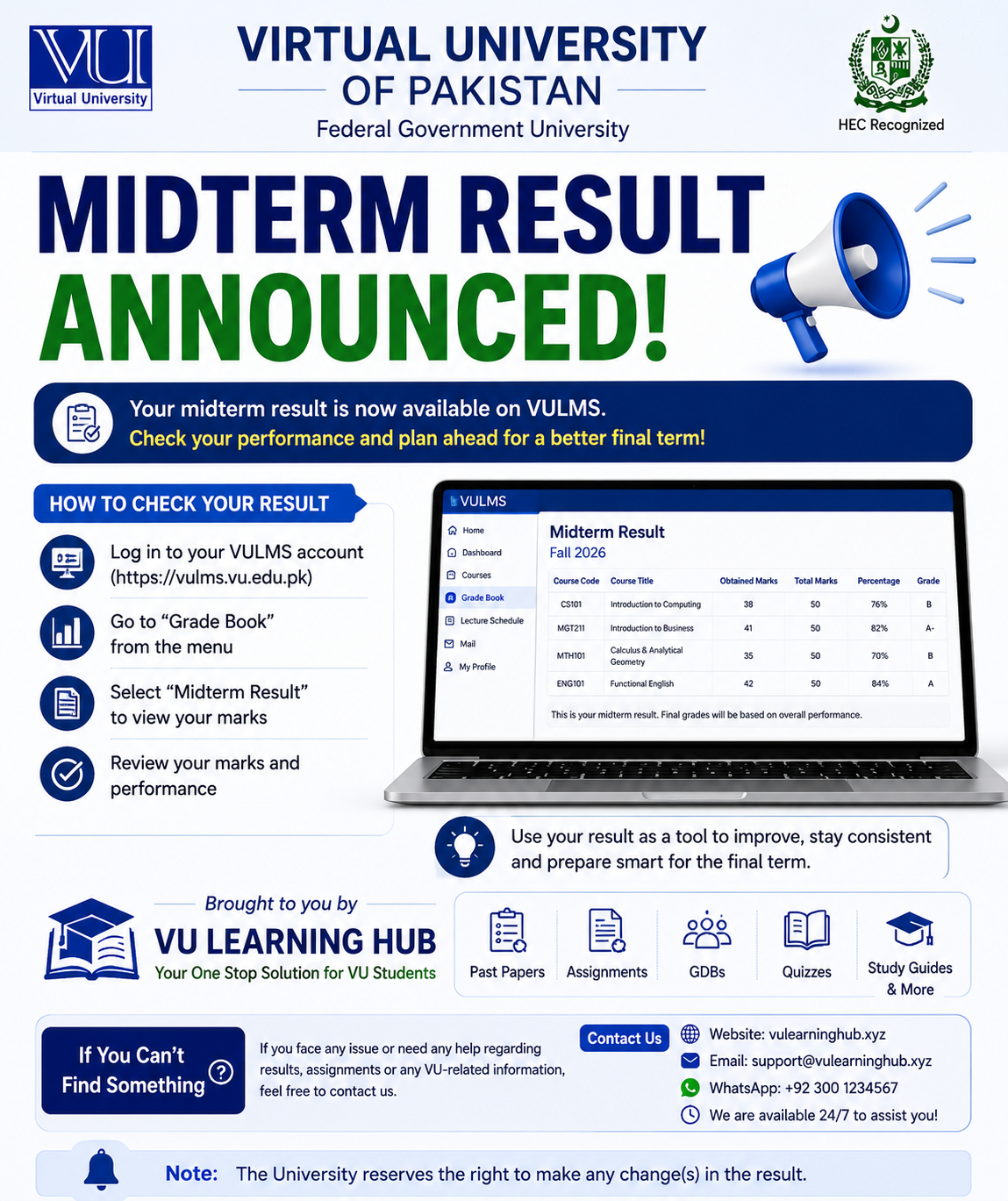
The moment your VU midterm result gets announced on VULMS, that small notification can trigger two very different reactions. Some students open it, see a solid score, and move on without giving it a second thought. Others open it, see something lower than expected, and spend the next few hours refreshing the page hoping the number changes. Neither reaction actually helps you, because a midterm result is not really an ending. It is a checkpoint that tells you exactly where you stand halfway through the semester, and how you respond to it matters far more than the number itself.
This guide walks you through what your midterm result actually represents, how to check and interpret it correctly on VULMS, and what to do next whether you are thrilled with your score or disappointed by it. Midterm results carry real weight toward your final GPA, but they are also one of the most useful pieces of feedback you get all semester, since they show you exactly which subjects need more attention before final term arrives. If you want to see how this term's exam pattern actually played out for other students, VULearningHub's midterm past papers archive is worth reviewing alongside your own result.
What Your Midterm Result Actually Tells You
A midterm result is often treated like a verdict, something final that either confirms you are doing well or proves you are falling behind. That framing causes more stress than it needs to, because a midterm score is really just a data point, not a conclusion. It reflects your performance on one specific exam, covering roughly the first half of your course content, and it exists specifically so you have a chance to correct course before the final exam decides the larger share of your grade.
Understanding this changes how you should read your result. If you scored well, it means your current study approach for that particular subject is working, and the goal becomes maintaining that same level of consistency through the second half of the course. If you scored lower than expected, it does not mean the semester is already lost. VU's grading structure typically weighs the final term exam more heavily than the midterm, along with assignments, quizzes, and graded discussion boards contributing throughout the semester, which means a weak midterm can still be balanced out by strong performance in the remaining components. What matters is treating the result as information rather than as identity. A single exam score does not define how capable you are in a subject, but ignoring what it is telling you does waste an opportunity that will not come around again until this course is over.
It also helps to look at your midterm result in the context of the class as a whole rather than in isolation. If an exam was widely reported as difficult, a moderate score might actually represent solid relative performance, while an easy exam with a similarly moderate score might signal an area you genuinely need to work on. Checking live paper experiences shared by other students right after the exam can sometimes give you that broader context before your official result even arrives.
How to Check Your VU Midterm Result on VULMS
Checking your midterm result is straightforward, but a surprising number of students miss details simply because they glance at the overall percentage and close the page immediately. Once you log into VULMS, your midterm results typically appear under the results or gradebook section, listed by course code alongside your obtained marks. Before doing anything else, confirm that every enrolled course actually shows a result. Occasionally a result posts later than others due to processing delays, and mistaking a delay for a missing exam can cause unnecessary panic.
Once you can see your results clearly, resist the urge to only look at the total number. VULMS often breaks midterm marks down by question or section, and this breakdown is far more useful than the final score alone. If you lost points primarily on a single question type, such as long subjective answers versus short conceptual ones, that tells you something specific about where your preparation gap actually is. Comparing this breakdown against your own exam notes, if you kept any, can help you understand whether the loss came from unclear concepts, poor time management during the exam, or simply not attempting a question fully.
It is also worth checking whether your result includes any remarks or annotations from the instructor, particularly for subjective sections. These comments are frequently ignored, but they often explain exactly why marks were deducted in a way that a raw number cannot. If your result seems unusually low compared to how you felt during the exam itself, most VU courses have a formal channel for requesting a rechecking or clarification, and it is worth using it rather than assuming the score is final and unquestionable. VULearningHub's notes section can also help you cross check specific concepts you may have misunderstood, especially for subjects where the gap between your expected and actual score feels confusing.
Understanding Your Midterm Marks Breakdown
Midterm exams at VU typically combine multiple choice questions with short and long subjective answers, and how your marks split across these two formats tells a more useful story than the combined total. Multiple choice performance usually reflects how well you covered the breadth of the syllabus, since these questions can be drawn from any part of the midterm content. If you scored well here, it generally means your overall content coverage was solid, even if specific areas still need reinforcement.
Subjective section performance works differently. These questions test depth rather than breadth, and losing marks here often points to one of two issues. Either you understood the general concept but struggled to explain it with the specific structure or terminology the instructor expected, or you genuinely had gaps in understanding a particular topic and it showed clearly once you had to explain it in your own words rather than select an answer from options. Distinguishing between these two causes matters a great deal for how you prepare going forward. A structure or explanation problem is fixable through practice with sample answers and past subjective questions, while a genuine content gap needs you to actually revisit the topic from scratch rather than just practicing how to phrase an answer you do not fully understand yet.
If you are unsure which category your weak areas fall into, comparing your answers against verified explanations can help clarify this quickly. Reviewing assignment solutions for related topics from the same course often reveals whether a concept you struggled with in the exam was also unclear in your assignment work earlier in the semester, which is a strong signal that the gap is genuinely about understanding rather than exam technique.
How Midterm Marks Affect Your Final GPA
One of the most common misconceptions among newer VU students is treating the midterm result as if it directly equals their semester grade. In reality, your midterm exam is only one component contributing to your final course grade, alongside assignments, quizzes, graded discussion boards, and the final term exam, which usually carries the heaviest individual weight of all these components. This distinction matters because it means a single weak midterm result, while worth taking seriously, is rarely enough on its own to determine your final outcome for the course.
That said, the weighting system also means you cannot simply ignore a low midterm score and expect strong assignment or quiz performance to fully compensate for it, since the final exam still needs a genuinely strong effort to meaningfully shift your overall grade. The most realistic way to think about your midterm result is as a signal for how much ground you specifically need to make up rather than a fixed part of a formula you have already lost. A student who scored moderately on their midterm but performs strongly across assignments, quizzes, and the final exam often ends up with a noticeably better final grade than their midterm score alone would suggest.
This is exactly why using the weeks between midterm results and final exams matters so much. Rather than fixating on the midterm number itself, use it as a diagnostic tool to identify exactly which courses need more attention during the remaining weeks of the semester. If two of your five courses came back weaker than expected, that is valuable information telling you where to concentrate your limited study time rather than spreading it evenly across every subject regardless of actual need.
What to Do If Your Midterm Result Is Lower Than Expected
A disappointing midterm result understandably brings frustration, but how you respond in the days immediately after matters more than the frustration itself. The first useful step is resisting the urge to either panic or completely disengage from the subject. Both reactions waste the exact window of time you need to actually improve your standing before the final exam arrives and the weighting shifts even more heavily against you.
Start by identifying specifically where the marks were lost, using the breakdown discussed earlier, rather than treating the entire subject as a lost cause. In most cases, a low midterm score comes from a handful of specific topics or question types rather than a complete lack of understanding across the whole course. Once you know which areas need work, revisit those specific topics using your handouts and any supplementary notes available, rather than restarting your preparation from the very beginning of the syllabus. VULearningHub's handouts section is organized by course, which makes it easier to go straight to the specific chapters connected to your weak areas instead of working through material you already understand well.
It also helps to reach out for support rather than trying to fully close the gap alone, especially if your semester is already demanding due to work or other responsibilities. If managing the remaining coursework alongside catching up on a specific subject feels overwhelming, VULearningHub's premium LMS support exists specifically for students in that position, helping manage assignments, quizzes, and graded discussion boards so you can direct your own study time toward the areas your midterm result flagged as weak, rather than spreading yourself thin across every single task in the course.
What to Do If You Scored Well on Your Midterm
A strong midterm result feels good, and it should, but the real value of a good score comes from what you do with the momentum rather than the score itself. The biggest risk after a strong midterm is easing off, assuming the hard part of the course is already behind you. In reality, the final exam usually covers new material and often carries more weight than the midterm, which means a good first half score does not guarantee a good final outcome unless you maintain the same consistency going forward.
Use a strong result as confirmation that your current approach to that subject is working, then apply the same habits to courses where your midterm result was less impressive. If you built a consistent study routine, kept up with lecture videos on schedule, or used specific resources effectively for a subject where you scored well, identify exactly what worked and replicate it deliberately in your weaker subjects instead of assuming success in one course will automatically transfer elsewhere. Different courses genuinely require different approaches, particularly between more conceptual subjects and computational or technical ones, so the transfer needs to be intentional rather than accidental.
It is also worth using strong subjects as a source of confidence rather than complacency during a demanding semester. Students juggling multiple courses alongside work or family responsibilities often feel pulled in every direction at once, and knowing that certain subjects are firmly under control lets you allocate more mental energy toward genuinely difficult ones without feeling like everything is equally urgent. Reviewing quiz preparation material through quiz focused notes can help you maintain that same strong performance in quizzes and graded discussion boards through the rest of the semester, keeping your overall course standing consistent rather than letting a strong midterm fade into a weaker final result.
Using Midterm Results to Prepare Smarter for Final Term
The single most valuable thing you can do with a midterm result, regardless of whether it was strong or weak, is treat it as direct input for how you prepare for finals rather than filing it away and moving on. Final term exams generally cover the second half of course content, but strong performance often still depends on how well you understood the foundational concepts introduced during the first half, the same material your midterm actually tested. A weak midterm score in a foundational topic is worth revisiting before finals even begin, since building later concepts on a shaky foundation tends to compound the problem rather than resolve it naturally over time.
Practically, this means using your midterm result to build a study priority list rather than treating all your remaining courses and topics as equally urgent. Subjects and specific topics where you lost the most marks deserve earlier and more focused attention, while subjects where you performed well can be maintained through lighter, consistent review rather than intensive re-study. This kind of prioritization becomes especially important as final exams approach and study time gets genuinely limited across multiple courses at once.
Past exam patterns are also worth reviewing at this stage, since final term question styles often mirror the structure used in midterms for the same course. Browsing final term past papers alongside your midterm result gives you a realistic sense of what to expect, rather than preparing based on assumptions about difficulty or format. Combining a clear understanding of your own weak areas with a realistic picture of how the final exam is likely to be structured puts you in a genuinely stronger position than simply studying harder without direction, which is often what separates students who improve significantly between midterm and final results from those whose scores stay roughly the same across both exams.
Final Thoughts on Your Midterm Result
Your VU midterm result, whether it turned out better or worse than expected, is ultimately a tool rather than a verdict. It exists to give you a clear, honest picture of where you stand halfway through the semester, and the students who benefit most from it are the ones who use that information deliberately rather than either celebrating too early or giving up too soon. Check your breakdown carefully, understand exactly where marks were gained or lost, and let that understanding shape how you spend your remaining study time before final exams.
Whatever your result looked like this term, the weeks between now and finals are where the real difference gets made. Review your weak subjects using the specific resources built around VU's own course structure, keep up with quizzes and assignments consistently, and treat every remaining assessment as a chance to strengthen your final grade rather than something to get through passively. VULearningHub's handouts, notes, and past papers are organized specifically to support this exact stretch of the semester, so you are not trying to figure out final term preparation entirely on your own.
Does a low midterm result mean I will fail the course? Not necessarily, since assignments, quizzes, graded discussion boards, and the final exam all contribute to your overall grade, and a weak midterm can often be balanced out by stronger performance across the remaining components. Can I request a rechecking if I believe my midterm was marked incorrectly? Yes, most VU courses have a formal process for requesting clarification or rechecking, and it is worth using this channel through contact support if your score seems inconsistent with your actual exam performance. How much does the midterm exam typically count toward my final grade? The exact weighting varies by course and instructor policy, but the final term exam generally carries a heavier weight than the midterm, which is why consistent effort through the rest of the semester still matters significantly.