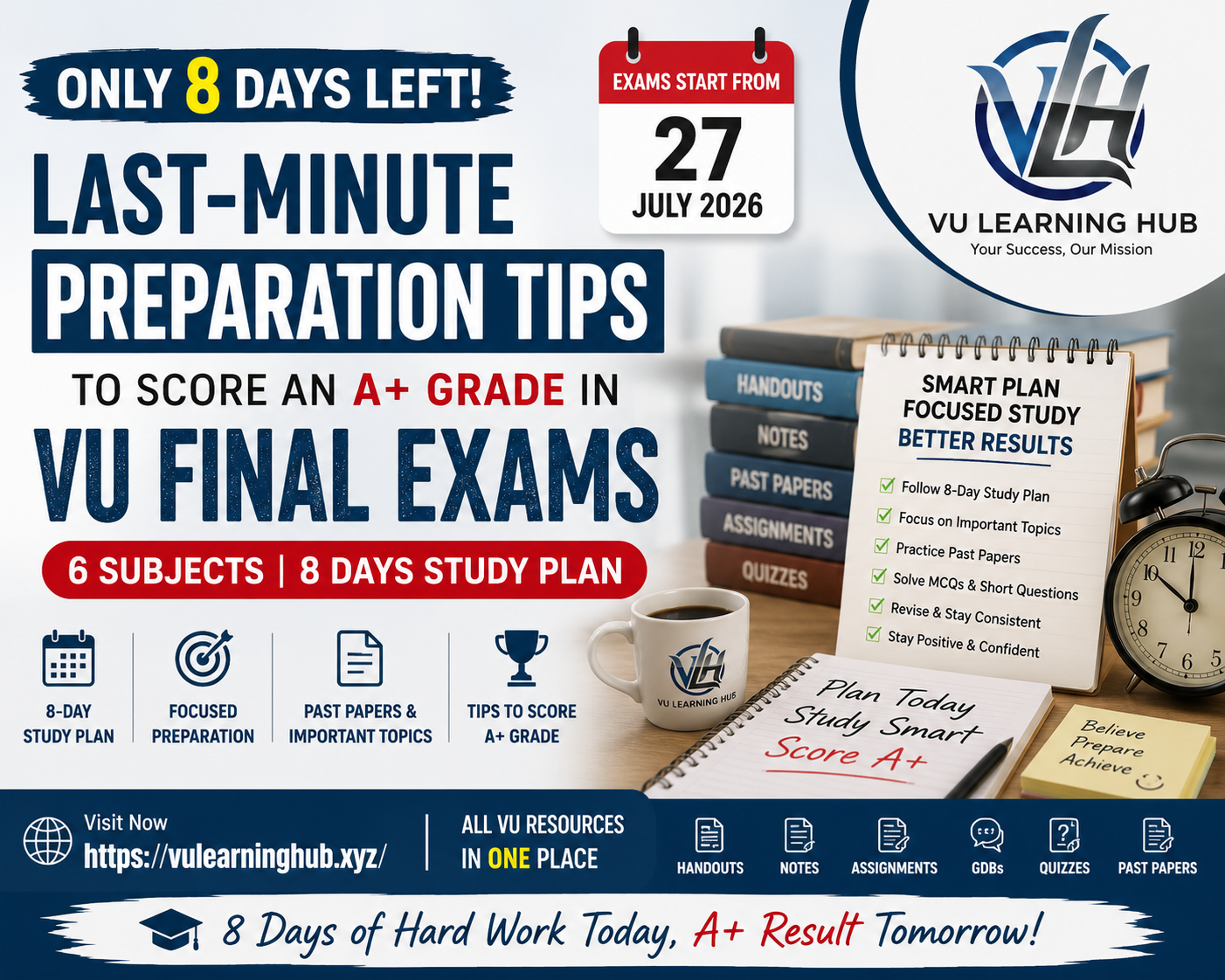
VU final exams 2026 start from 27 July, and the date sheet is already out. If you are only now realizing how close the exam dates are, take a breath first. Eight days is not a lot of time, but it is enough to turn a shaky semester into a solid result if you use it wisely. Panic wastes hours you don't have. A clear plan does not.
This guide is built specifically for students who need VU final term preparation for 6 subjects in just over a week. We will walk through a realistic day-by-day study plan, how many hours you actually need to study, what to prioritize, subject-wise strategies, common mistakes to avoid, and a simple exam day checklist. If you are searching for how to prepare for VU final exams with limited time, this is the roadmap to follow.
Can You Really Prepare 6 Subjects in 8 Days?
Let's be honest with each other. You cannot master six subjects in eight days the way you would with a full semester of consistent study. Nobody can, and any resource promising that is not being realistic with you. What you can do is prepare smart enough to pass comfortably and push for good grades in the subjects where you have some existing base knowledge.
The first goal should always be passing every subject. Do not get distracted trying to score full marks in one subject while risking a fail in another. VU marking usually rewards students who attempt every question with reasonable effort, so spreading your energy evenly across all six subjects matters more than perfecting just one or two.
Once you feel confident that you can pass a subject, then shift extra effort toward improving your grade in it. This is where past papers, important short questions, and a second revision round come in. Think of your eight days in two phases: first, cover the basics of every subject so nothing is completely unknown to you. Second, use the last two days to strengthen weak areas and revise everything.
Also, be strategic about subject order. Start with subjects that have more weight in your GPA or that you find genuinely harder. Leave subjects you already understand well for later days, since they will need less time. This approach keeps the workload balanced instead of leaving the toughest subject for the final day when your energy is lowest.
The 8-Day Study Plan for VU Final Exams
A study plan only works if it is simple enough to actually follow. Here is a practical VU study plan you can adapt based on your own subjects and exam dates.
DayFocus AreaDay 1Subject 1 handouts, MCQs, and short questionsDay 2Subject 2 handouts, MCQs, and short questionsDay 3Subject 3 handouts, MCQs, and short questionsDay 4Subject 4 handouts, MCQs, and short questionsDay 5Subject 5 handouts, MCQs, and short questionsDay 6Subject 6 handouts, MCQs, and short questionsDay 7Revise weak topics across all subjects + past papersDay 8Final revision, light practice, rest, and exam preparation
Adjust this table according to your actual exam dates. If two of your papers fall close together, give the earlier one more days and compress the later ones. The order in the table is a template, not a fixed rule.
On each subject's dedicated day, don't try to read every single handout line by line. Skim through the handouts to identify important topics, then focus most of your time on solving MCQs and short questions related to those topics. This method covers more ground in less time and mimics what your actual paper will look like.
Day 7 is arguably the most important day in this entire plan. This is when you go back through everything you marked as difficult or uncertain during the first six days. Pair this with solving at least one or two past papers per subject if time allows, since VU often repeats question patterns across semesters.
Day 8 should be lighter. Your brain needs rest before an exam, not more new information. Do a quick final revision of formulas, definitions, and key concepts, then stop studying a few hours before the exam so you walk in calm and clear-headed.
How Many Hours Should You Study Each Day?
For this compressed timeline, aim for 8 to 10 focused hours of study per day. This might sound like a lot, but the word "focused" matters more than the number itself. Four hours of distracted, half-hearted studying achieves far less than four hours of genuine concentration.
The most effective way to structure these hours is the 50-10 method. Study with full attention for 50 minutes, then take a 10-minute break away from your phone and books. This pattern keeps your brain from burning out and actually improves how much information you retain compared to studying for three hours straight without stopping.
Break your day into blocks. For example, you might do three 50-minute sessions in the morning, take a longer lunch break, do three more sessions in the afternoon, and finish with two sessions in the evening. That adds up to roughly 8 sessions, which is close to 7 hours of pure study time plus breaks, fitting comfortably into a 10 to 12 hour day.
Don't sacrifice sleep to add more study hours. A tired brain forgets information faster and struggles to recall it during the exam. Aim for at least 6 hours of sleep even during this intense week. Students who pull all-nighters right before finals often perform worse than those who studied slightly less but rested properly.
Priority Order: What to Study First
When time is tight, not all study material deserves equal attention. Follow this priority order to make the most of your remaining days:
Start with handouts, since VU exams are drawn heavily from official course content. Focus on the topics your instructor emphasized during the semester if you remember any hints from lectures or announcements. Next, move to past papers, which are one of the most reliable resources for understanding actual question patterns and difficulty levels. Many VU students report that a good portion of their final paper closely resembles previous semesters' questions.
After past papers, revisit your assignments and GDB topics. These are not just for submission marks. VU frequently pulls exam questions from concepts covered in assignments and graded discussion boards, since these highlight areas the university wants you to understand deeply. If you already have solved assignments saved, review them instead of solving from scratch.
Quiz files come next in priority. Reviewing quiz questions helps reinforce basic concepts and refreshes your memory on smaller details that are easy to overlook. Finally, spend remaining time on important short questions, which are often shared in study groups or found in solved past paper compilations. These give you a quick way to check whether you actually understand a topic or just recognize it.
If you're running short on original notes, our VU handouts and notes section organizes course material by subject, which can save you the time of hunting through scattered folders. Having reliable resources in one place makes a real difference when every hour counts.
Subject-Wise Strategy for the Final Push
Different subject types need different approaches, especially when time is limited. Treating a programming course the same way you treat an English course wastes valuable hours.
Programming Courses
For programming subjects, theory alone will not get you through the exam. Practice writing and tracing code by hand, since many VU programming papers ask you to write output or complete missing code sections. Focus on core concepts like loops, functions, arrays, and object-oriented basics rather than trying to memorize entire programs. If you understand the logic, you can adapt it to whatever variation appears in the paper.
Mathematics Courses
Math and statistics courses reward practice over reading. Reading a formula does not mean you can apply it under exam pressure. Solve as many numerical problems as you can from past papers, and keep a small sheet of important formulas that you review repeatedly during your final two days. Understanding the steps behind a solution matters more than memorizing the final answer.
Business Courses
Business and management subjects usually involve conceptual and case-based questions. Focus on understanding definitions, differences between similar concepts, and real-world examples that illustrate theories. Short questions in business subjects often ask you to explain a concept in your own words, so practice writing brief, clear answers instead of just reading passively.
English and General Courses
For English and general education courses, grammar rules, vocabulary, and comprehension patterns matter most. Practice past paper questions related to sentence correction, essay structure, and reading comprehension. These subjects often have more predictable question formats, which makes past papers especially valuable for last-minute preparation.
Mistakes to Avoid During These 8 Days
Even with a solid plan, certain habits can quietly sabotage your preparation. Avoid starting completely new topics on the last day before your exam. This creates unnecessary panic and rarely results in real understanding, since new concepts need time to sink in.
Don't ignore MCQs while focusing only on long questions. Many VU papers carry significant weight in MCQs, and these are often based on smaller details students skip while skimming handouts. A few minutes reviewing MCQ-style questions can secure easy marks.
Studying for hours without breaks feels productive but actually reduces how much you retain. Your focus naturally drops after 45 to 50 minutes, so pushing through without pausing just wastes time. Similarly, skipping sleep to cram more hours backfires, since exhaustion affects memory recall exactly when you need it most.
Relying only on AI-generated summaries without reading actual handouts is another common mistake. Summaries can miss important details or oversimplify concepts that appear in exact wording on your paper. Use AI tools to save time, not to replace understanding.
Lastly, don't skip practicing calculations or coding just because you understand the theory. VU exams test application, not just recognition. A concept you can explain but not apply will not help you solve a numerical problem or write working code under time pressure.
Exam Day Checklist
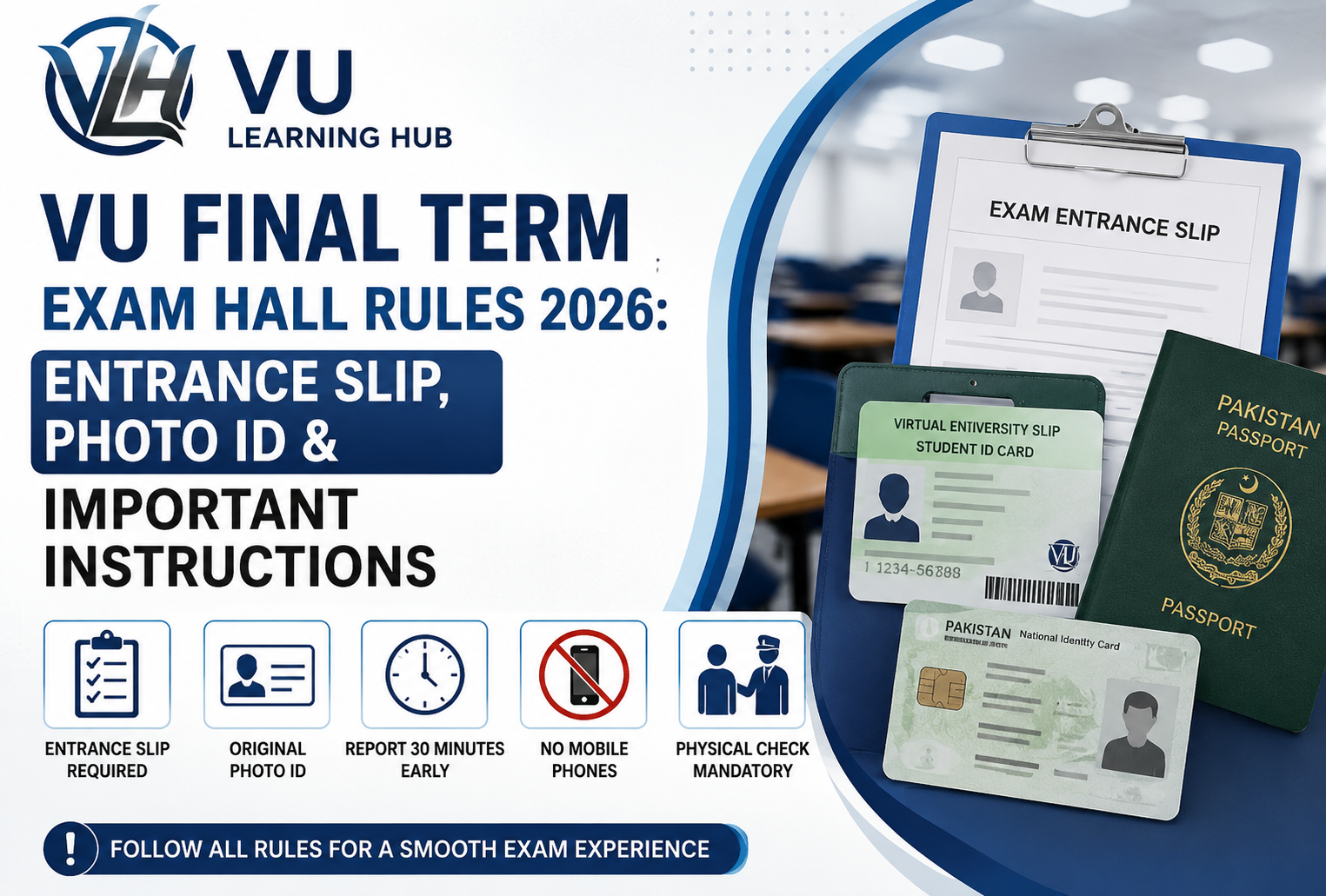
Before you leave for your exam center, make sure you have everything ready the night before rather than searching for it in the morning rush. Keep your student ID card easily accessible, along with a printed or digital copy of your date sheet showing the correct date, time, and center for that specific paper.
If your center requires it, carry your CNIC or B-Form as additional identification. VU exam centers can be strict about identification, and forgetting this document has caused unnecessary stress for students in past semesters. Double check your center address the night before, especially if it is your first time visiting that location.
Plan to reach the exam center 30 to 45 minutes early. This buffer accounts for traffic, finding the right room, and settling in mentally before the paper starts. Rushing in at the last minute adds stress that affects performance, even if you were well prepared.
Familiarize yourself with VU exam rules regarding prohibited items, seating arrangements, and conduct during the paper. Following these rules carefully avoids any complications that could affect your exam eligibility or result.
Free Resources to Speed Up Your Preparation
With only eight days left, you don't have time to search endlessly across scattered files and outdated links. Having organized access to handouts, notes, past papers, assignments, quizzes, and solved MCQs in one place saves hours that you can redirect toward actual studying.
VULearningHub provides subject-wise VU past papers and solved MCQs that many students use during exam weeks to quickly identify important topics and practice under realistic conditions. Pairing organized handouts with genuine past paper practice tends to be the most efficient combination for last-minute preparation, since it covers both content knowledge and question format familiarity at the same time.
Whenever possible, study with a friend or classmate on the same course. Explaining a concept to someone else quickly reveals whether you actually understand it or just think you do. Group study during crunch time can also help you divide topics and cover more ground together.
Conclusion
Eight days is tight, but it is enough time to prepare seriously if you commit to a clear plan and stick to it. Focus on understanding key concepts rather than trying to memorize everything word for word, since VU papers often test application over rote recall. Prioritize handouts, past papers, and MCQs, protect your sleep, and take short breaks to keep your mind sharp through each study session.
Stay consistent for the remaining days, trust the plan, and walk into your VU final exams 2026 with a calm, prepared mindset. That combination matters far more than cramming every waking hour ever could.
Frequently Asked Questions
Is it possible to pass 6 subjects with only 8 days of preparation? Yes, if you focus on high-yield resources like handouts, past papers, and MCQs instead of trying to read everything in detail. Consistent daily effort across all six subjects gives you a realistic chance to pass and even score well in subjects you understand better.
Should I study new topics or only revise on the last day?
Stick to revision only. The last day should focus on reviewing what you have already studied, checking formulas and definitions, and resting well before the exam rather than absorbing new material.
Are VU past papers enough for final exam preparation?
Past papers are extremely useful for understanding question patterns, but they should be combined with handouts to ensure you are not missing newly added or updated content for the current semester.