Every VU student knows the drill. Download past papers, try to solve them, check your answers, feel bad about the ones you got wrong, repeat. It works, but slowly. What if you flipped the entire process upside down?
There is a study technique that almost nobody talks about, and it sounds completely wrong the first time you hear it. Instead of attempting questions and then checking answers, you start with the answers. You read the solved paper first, then work backwards to understand why each answer is correct. It feels like cheating. It is not. It is one of the fastest ways to build real understanding, and today I am going to show you exactly how to do it.
Why Normal Past Paper Practice Is Slow
Let us be honest about the standard method. You sit with an unsolved past paper, stare at question one, try to recall the concept from the handout, write something, move on, and at the end you check the answer key. For every question you got wrong, you go back to the handout, find the topic, and re-read it.
The problem is time. A typical VU final term paper has dozens of MCQs plus subjective questions. If you attempt the full paper blind, you might spend two hours just trying to answer, then another hour reviewing mistakes. That is three hours for one paper, and half of that time was spent guessing.
Worse, when you guess wrong, your brain stores the wrong answer first. Researchers have shown that a wrong first guess can leave a sticky memory trace — and unlearning it costs extra effort later. Starting blind is not just slow, it can actually plant wrong information in your head.
What Is the Reverse Method
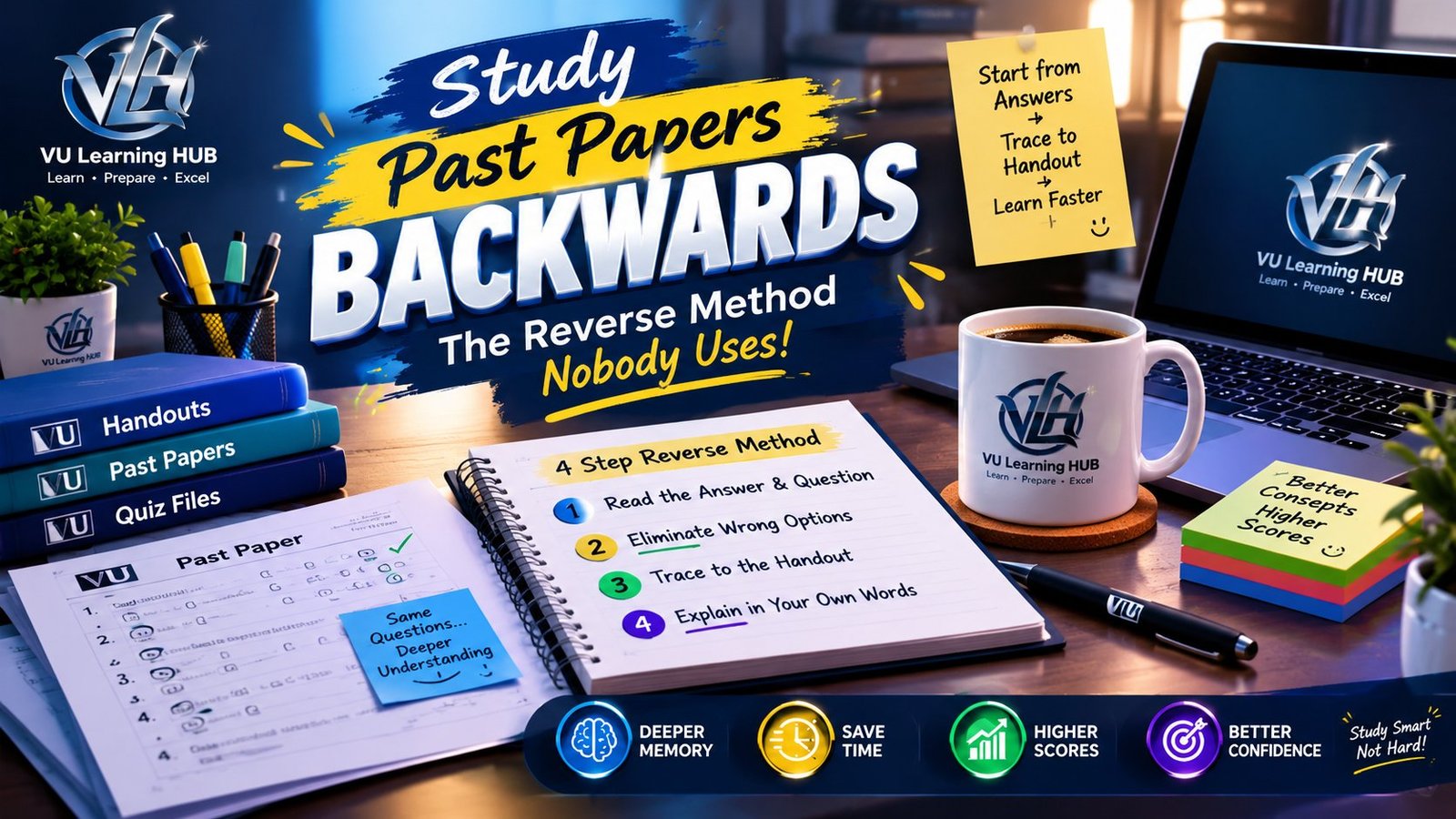
The Reverse Method flips the order completely. Here is the core idea in one line: study the solved paper as your textbook, and use the unsolved paper only for testing at the very end.
Step one, get a solved past paper for your subject. Our Past Papers section has solved papers for hundreds of VU subjects, so pick your course code and download one. Step two, read every question together with its correct answer, slowly, like you are reading a story. Do not try to answer first. Just absorb: question, correct answer, question, correct answer.
Step three is where the magic happens. For each question-answer pair, ask yourself one question: why is this the answer and not the other options? Then open your handout and find the exact paragraph or formula that proves it. You are tracing the answer back to its source, like a detective following footprints in reverse.
How Your Brain Learns Backwards
This works because of something learning researchers call elaborative encoding. When you start from the correct answer and trace it back to the concept, your brain builds a two-way connection: concept to answer, and answer to concept. Normal studying only builds the first direction.
Think of it like learning a city. The normal method is like being dropped in random streets and trying to find your way to the main square. The reverse method is like starting at the main square and walking every road outward. By the end, you know the whole map, not just one route.
There is also a confidence benefit. When students attempt papers blind and score 40 percent, they feel defeated and avoid past papers altogether. When they study solved papers first, every session feels productive. They finish a paper thinking I now understand 50 questions instead of I failed 30 questions. That emotional difference decides whether you keep studying or give up.
The 4-Step Reverse Method in Detail
Let me walk you through the exact process with a real example. Suppose you are preparing CS101 and the solved paper has this MCQ: Which of the following is an example of system software? A) MS Word B) Operating System C) Web Browser D) Media Player. The marked answer is B.
Step 1: Read and accept. Read the question and the correct answer together. Say it in your head: the operating system is system software. Do not quiz yourself yet. Just let it in.
Step 2: Kill the wrong options. Look at each wrong option and explain why it is wrong. MS Word is application software, not system software. Web browsers and media players are also application software. By eliminating all three, you have now learned the full category boundary, not just one fact.
Step 3: Trace to the handout. Open your CS101 handout and find the section on types of software. Read the definition of system software. Now the answer is anchored to the official course material. If the exam asks a twisted version of this question, you will recognize it because you know the concept, not just the memorized answer.
Step 4: Teach it in one line. Close everything and say the concept aloud in your own words: system software manages hardware, like the operating system, while application software like Word runs on top of it. If you can say it simply, you own it.
Do this for every question in the paper. A 50-MCQ paper takes about 90 minutes this way, and you will know the material deeply.
When to Use It and When Not To
The Reverse Method is perfect for MCQ-heavy subjects: CS101, MTH101, ENG101, and most 100-level courses where the paper is mostly objective. It is also excellent for the final 3 to 4 days before the exam, when you need maximum coverage in minimum time.
It is less useful as your very first introduction to a subject. If you have never opened the handout, start with at least one reading of the material first. The reverse method assumes you have seen the concepts once; it is a mastery technique, not a first-contact technique.
One more caution: always use solved papers from a trusted source. A wrong answer key studied backwards will teach you the wrong thing twice as fast. Stick to verified solved papers, and when something looks suspicious, cross-check with the handout immediately.
Combining Reverse Study With Normal Practice
Here is the full weekly system. Days 1 to 4: reverse-study two solved papers per subject, tracing every answer to the handout. Day 5: attempt one completely unsolved paper under timed conditions, no answer key, just like the real exam. Day 6: review only the questions you got wrong on day 5 using the reverse technique on those specific questions.
This combination gives you the best of both worlds. The reverse days build deep understanding fast. The timed day builds exam temperament: speed, pressure handling, and the discipline of moving on from stuck questions. Our Live Papers section is a good place to find practice material for that timed day. Students who only do timed practice plateau. Students who only reverse-study sometimes freeze under pressure. Together, they cover everything.
And when you want to test whether a concept truly stuck, try a Quiz File for your subject after a reverse-study session. If you can handle fresh questions you have never seen, the method worked.
Final Thoughts
Studying backwards feels strange for exactly one session. After that, it feels obvious. Why would you spend hours guessing when you could spend the same hours understanding? The answer key is not the enemy of learning; used correctly, it is the fastest teacher you have.
So here is your challenge: pick one subject today — the one whose paper is coming up soonest. Download one solved past paper from our Past Papers section, open the matching handout, and reverse-study just the first 20 questions. Step 1 to 4, no skipping the handout trace. If your score on a fresh quiz does not feel different after that, I will personally owe you an apology.
And if you know a friend who keeps failing the same past papers over and over, share this post with them. One strange idea can be worth more than a hundred hours of the old routine. Be the friend who shares the good stuff.
FAQs
Q: Is studying solved papers first not just memorising answers?
A: It becomes memorisation only if you skip step 3, tracing back to the handout. The tracing step is what converts answer-reading into concept-learning. Without it, yes, it is just cramming. With it, it is deep study.
Q: Where can I find reliable solved past papers for VU subjects?
A: VU Learning HUB offers solved past papers for hundreds of VU course codes, along with handouts and quiz files. Always verify any doubtful answer against your official handout.
Q: How many solved papers should I reverse-study per subject?
A: Three to four solved papers per subject is the sweet spot. The first paper teaches you the most; by the fourth, you will start predicting answers, which means the patterns are locked in.
Q: Can I use this method for subjective questions too?
A: Yes, with a small change. For subjective questions, read the model answer first, then outline its structure: definition, explanation, example, conclusion. Then close it and rewrite the answer in your own words from the outline.
Allah aap ki mehnat ko kamyab kare, aur aap ke papers aasaan farmaye. Ameen!
- Kinza Kanwal, VU Learning HUB