Here is a number that should bother you: most VU students spend four to six hours on an assignment and get 6 out of 10. A smaller group spends two hours and gets 9. The difference is not effort. It is not intelligence either. It is method.
I have watched this pattern repeat every single semester. The assignment drops on the LMS. Half the students ignore it until the night before the deadline. Then there is a panic, a flurry of copied paragraphs from Google, a file named something like “assignment1_final_FINAL2.docx,” and a submission at 11:57 PM that earns a polite 6 marks and a comment from the instructor that nobody reads.
It does not have to be this way. An assignment is one of the most predictable assessments in your entire degree. The questions come from your handouts. The marking scheme rewards the same things every time. And unlike a timed quiz, nobody is rushing you — you have days. The students getting full marks are not geniuses. They just follow a process.
This is that process.
First, Understand What the Instructor Is Actually Grading
Before you type a single word, get this straight: a VU assignment is not testing whether you can find information. It is testing whether you understood the lesson and can present that understanding clearly in your own words.
Every assignment question maps to specific handout topics. The instructor has a marking scheme — usually something like: correct concept (40%), explanation in own words (30%), relevant example or application (20%), presentation and formatting (10%). The exact split varies, but the shape is always the same. They want to see that you read the lesson, understood it, and can explain it back.
This means two things. First, an answer copied from the internet fails the single most heavily weighted criterion — it proves nothing about your understanding, and instructors can smell copied text from three paragraphs away. Second, a short, clear, well-structured answer in your own words will beat a long, rambling, copied answer every single time. Length is not a marking criterion. Clarity is.
Read the assignment questions twice before doing anything else. Underline the action words: “explain,” “compare,” “discuss,” “calculate,” “justify.” Each one demands a different kind of answer, and answering an “explain” question with a “list” is one of the quietest ways students lose marks. Know what is being asked before you start answering it.
Step 1: Gather Your Material (45 Minutes)
Do not start writing immediately. That is the number one mistake. The students who open a blank document and start typing produce disorganized answers because they are thinking and writing at the same time. Separate the two jobs.
Start with your handouts. Find the lessons the assignment questions come from — the question almost always names the topic directly, or you will recognize it from the terminology. Read those lessons properly, not skimmed. You are not memorizing; you are collecting raw material: definitions, key points, formulas, examples.
As you read, jot down rough notes for each question: three or four bullet points per question, in your own shorthand. Ugly is fine. Nobody sees this. You are building a pile of ingredients before you start cooking.
If a question references something the handout only covers briefly, that is normal — assignments are designed to make you think beyond the text. This is where you add one outside source: the course’s recommended book, a lecture video, or one reliable website. One source, not ten. You are a student writing an assignment, not a researcher writing a thesis. For quick access to organized handouts and short notes when you need to revise a lesson fast, the subject-wise handouts on vulearninghub.xyz are arranged exactly for this kind of targeted study.
What you should have at the end of 45 minutes: for each question, a small cluster of bullet points — concepts from the handout, one example, and your own understanding of how they connect. That is your ammunition. Now you write.
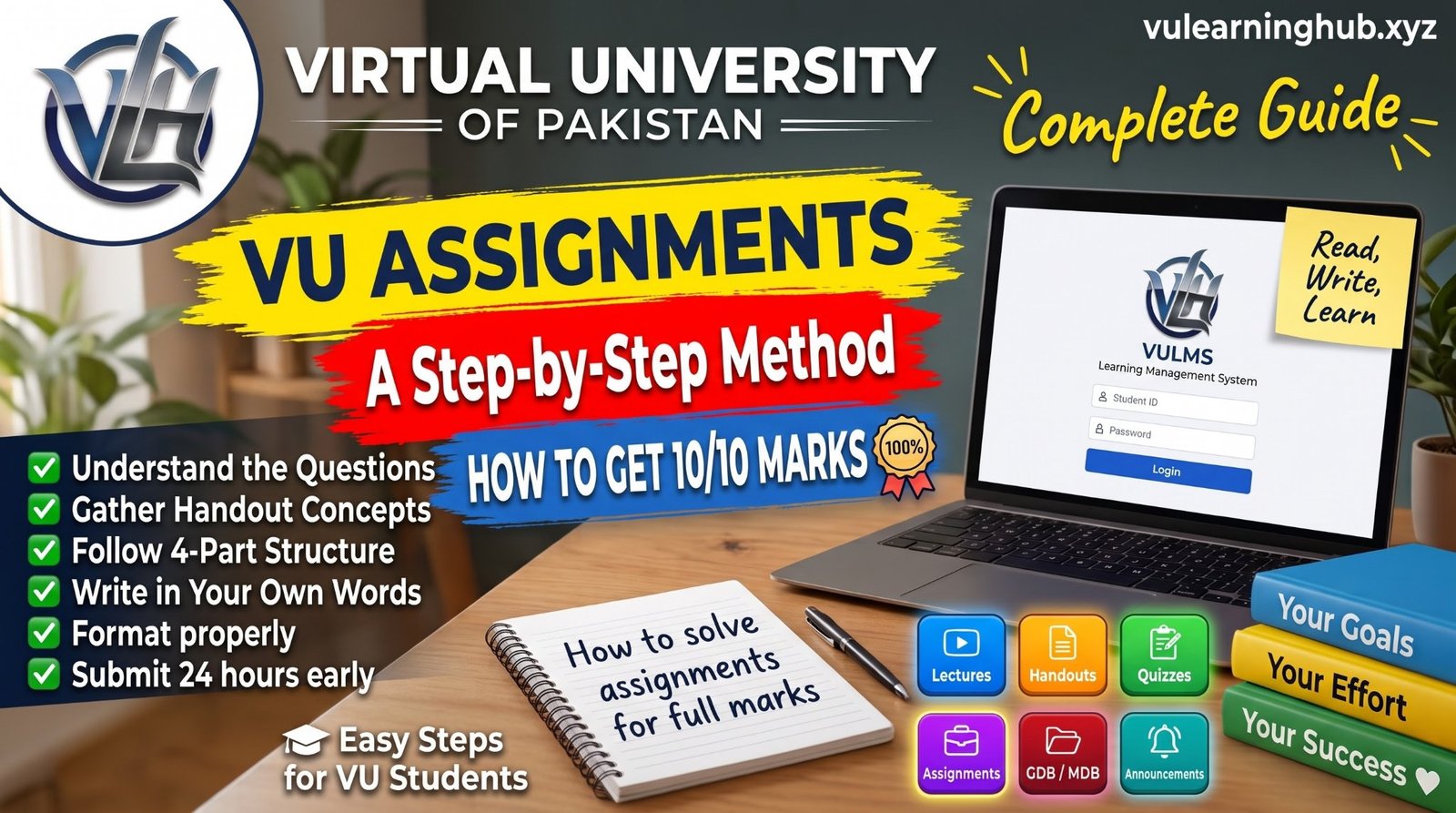
Step 2: Structure Every Answer the Same Way (The 4-Part Answer)
Here is the structure that works for virtually every theory-based assignment question. Memorize it, because you will use it for four years:
Part 1 — Direct opening (1-2 lines). Answer the question immediately. If it asks “What is X?”, your first line defines X. If it asks “Do you agree?”, your first line states your position. Never open with background throat-clearing like “In today’s modern world...” — instructors skip it, and it signals that you are padding.
Part 2 — Explanation (the main body). Unpack the concept in your own words, point by point. This is where your bullet points from Step 1 become sentences. Keep each point tight. If the question asks you to compare two things, use a small table — instructors love tables because they show organized thinking at a glance.
Part 3 — Example or application (2-4 lines). Connect the concept to something real: a business scenario, a daily-life situation, a worked calculation. This is consistently the highest-value part of an answer relative to its length. It proves understanding, and it is the part most students skip — which means it is also the part that makes your answer stand out in a pile of two hundred.
Part 4 — Closing line. One sentence that wraps up: restates your answer or draws the conclusion. It tells the grader the answer is complete and deliberate.
For numerical or problem-solving questions, the structure adapts naturally: state the given data and the formula first, show each calculation step clearly (never skip steps — method marks are real), box or bold the final answer, and add one line interpreting what the answer means. An answer of “x = 42” with no working gets a fraction of the marks of the same answer with visible steps, even when both are correct.
Step 3: Write in Your Own Words (The Plagiarism Section — Read This Carefully)
Let us talk honestly about plagiarism, because this is where students destroy their own marks without realizing it.
VU runs assignment submissions through similarity detection. When your answer matches internet sources or other students’ submissions beyond the allowed threshold, the consequences are not a small deduction — they can include zero marks for the assignment and, for repeat cases, disciplinary action. And here is what surprises most students: “changing a few words” of a copied paragraph does not fool the software. Neither does translating an English source into Urdu-style English, or copying from a “solved assignment” file circulating on WhatsApp groups. Those files are the most heavily matched sources in the entire system — hundreds of students submit from the same file, and the software flags every one of them.
The irony is that writing in your own words is actually easier than clever copying. Here is the technique: read the handout section, close it, and explain the concept out loud as if teaching a friend. Then write down what you just said. What comes out will naturally be in your own words, because it passed through your understanding first. This “read, close, explain, write” loop is the single most effective anti-plagiarism method I know, and it has the side benefit of actually teaching you the material — which is the entire point.
Quoting is fine when done properly: if you use a definition word-for-word from the handout, put it in quotation marks and keep it to a line or two. A definition quote is legitimate. A copied paragraph is not. The line between them is bright and every instructor sees it.
One more thing: never share your assignment file with classmates before the deadline, and never accept someone else’s file “just to see the format.” Cross-matching between student submissions is one of the easiest things for the system to detect, and both parties get penalized. Protect your own work.
Step 4: Format Like You Mean It
Presentation marks are the cheapest marks in the assignment. They cost you ten minutes and they are available to everyone, yet most students leave them on the table with sloppy formatting.
The non-negotiables:
- File format: Submit in the format asked — usually .doc/.docx. PDF is only acceptable if the instructions say so. A wrong format can mean your file is not even opened.
- File name: Use the format your instructor specifies, typically something like BC123456789_CS101_A1.docx (your VU ID, course code, assignment number). A file named “assignment final.docx” in a folder of two hundred submissions is asking to be misplaced.
- Cover/header: Put your name, VU ID, course code and title, assignment number, and instructor name at the top of the first page. Every time. It takes thirty seconds.
- Headings: Use clear headings for each question (e.g., “Question 1”, “Question 2”). If an answer has parts, label them (a), (b), (c). The grader should never have to wonder which question you are answering.
- Fonts and spacing: One readable font (Calibri, Arial, or Times New Roman), size 11 or 12, 1.15 or 1.5 line spacing. No rainbow colors, no five different fonts. Boring formatting is professional formatting.
- Page numbers: Add them. For multi-page assignments, they are basic courtesy to the grader.
- Tables and diagrams: Where a comparison or process is involved, a table or a simple diagram communicates more in less space than paragraphs. Label diagrams clearly.
Read your entire assignment once after formatting, top to bottom, as if you were the grader. Fix typos — they do not directly cost marks in most schemes, but they cost credibility, and credibility shades every judgment a tired grader makes. This final read takes ten minutes. Do it.
Step 5: Submit Early, Verify, and Keep Proof
The LMS deadline is not a suggestion. Late submissions in VU are typically not accepted at all — the upload link closes, and a closed link does not care about your internet problems, your load-shedding, or your cousin’s wedding.
Submit at least 24 hours before the deadline. This is not paranoia; it is experience. I have seen students lose entire assignments to LMS slowness on deadline night, when thousands of students are uploading simultaneously and the system crawls. The early submitter sleeps. The last-minute submitter refreshes a frozen page at 11:58 PM.
After uploading, do three things: first, download your submitted file back from the LMS and open it, to confirm the upload is intact and readable. Second, check that the submission status shows as submitted — not draft, not pending. Third, keep a copy of your file and a screenshot of the submission confirmation until your marks are announced. If anything goes wrong later, this is your evidence.
The Realistic Timeline: Two Evenings, Not One Panic Night
Here is how a full-marks assignment actually fits into a student’s week:
Evening 1 (about 1.5 hours): Read the questions twice. Gather material from handouts — the 45-minute collection step. Rough bullet points for each question. Done. Close the laptop.
Evening 2 (about 1.5 hours): Write the answers using the 4-part structure. Format the document. Proofread once. Submit — a day or more before the deadline.
Three hours total, spread over two relaxed evenings, versus six panicked hours the night before producing a weaker result. The method is not just about marks; it is about getting your evenings back.
The Mindset That Separates 6-Mark Students from 9-Mark Students
The 6-mark student asks: “How do I finish this assignment?” The 9-mark student asks: “How do I answer this question well?” That tiny shift — from finishing to answering — changes everything: it changes whether you read the lesson first, whether you write in your own words, whether you add the example, whether you proofread.
An assignment is not a hurdle between you and your degree. It is a rehearsal for your final paper, where the same questions return wearing different clothes. Every assignment you solve properly is a chunk of your final exam already prepared. The students who treat assignments as exam preparation consistently outperform the ones who treat them as paperwork — in the assignment marks and, months later, in the final term.
So for your next assignment, try the method exactly as written: gather first, structure every answer in four parts, write it yourself, format it properly, submit it early. Then look at your marks, and look at how you felt doing it. I think you will find, as so many students have, that full marks were never about working harder. They were about working in the right order.
And when you need the raw material — handouts, short notes, past papers to see how assignment topics reappear in exams — the subject-wise study material on vulearninghub.xyz is organized to support exactly this workflow. Use it as your first stop, not your last resort.