Final term exams are the most important part of every VU semester. They decide a big chunk of your final grade, and most students feel a mix of pressure and confusion right before the exam schedule is announced. If you are a Virtual University student preparing for your upcoming final term papers, understanding the exact exam pattern can save you from last-minute panic and help you plan your revision smartly.
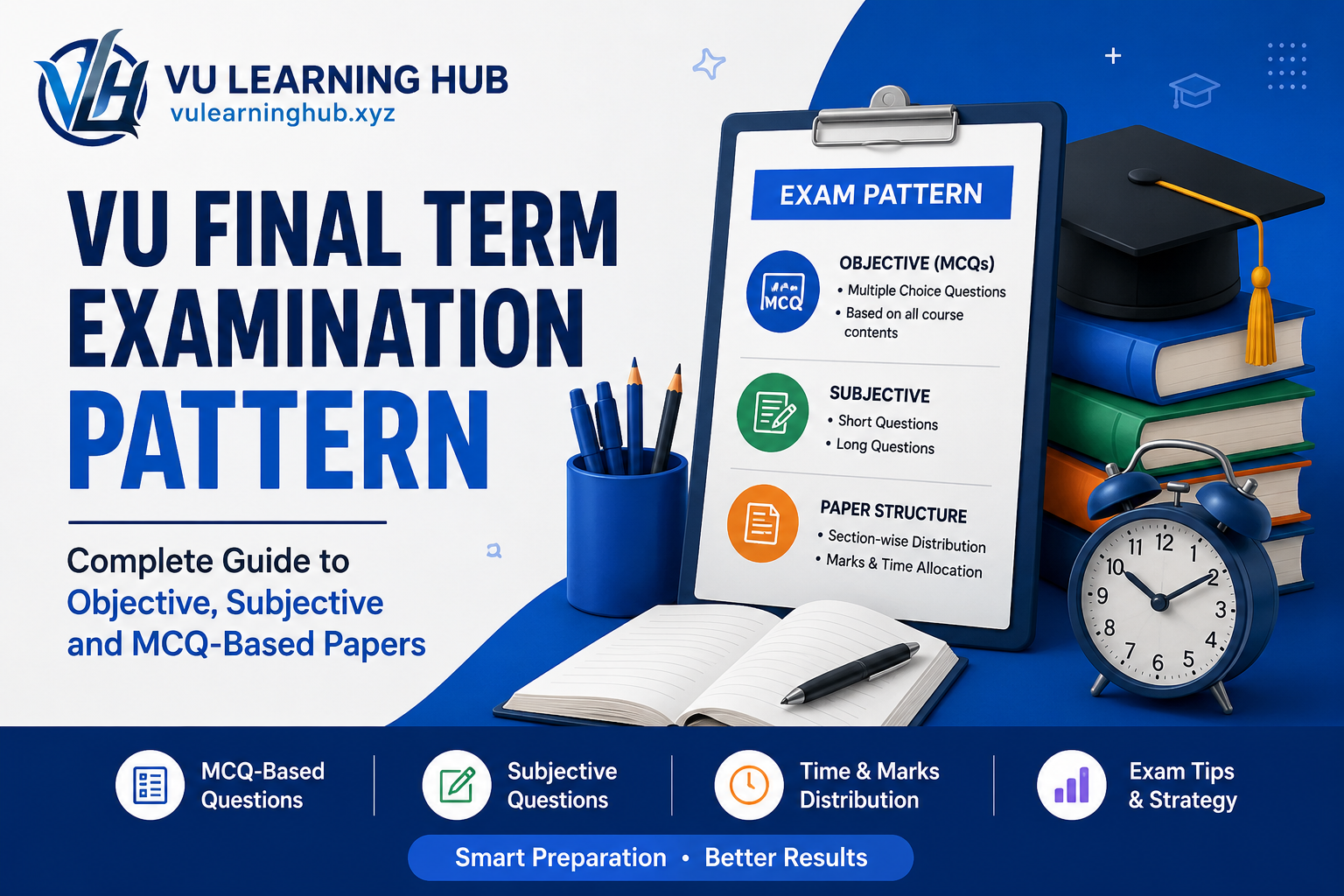
Virtual University has released the official final term examination pattern for this semester, and it applies to both subjective plus objective courses and MCQs based courses. In this guide, we will break down every part of the pattern in simple words, explain what each section means for your preparation, and share practical tips to help you score better within the given time limit. Whether you are attempting a paper with short and long questions or a fully MCQ based subject, this article covers everything you need to know before exam day.
Understanding the VU Final Term Exam Pattern
Every semester, VU updates and confirms its examination structure so students know exactly what to expect on paper day. This time, the final term examination duration has been fixed at 90 minutes for all courses, whether the subject follows the subjective and objective format or a fully MCQs based structure. This shorter time window means students cannot afford to waste even a few minutes reading unrelated material or attempting questions out of order.
The pattern is designed to test how well you understand core concepts rather than how much you can memorize word for word. VU exams usually pick questions from all units of the course, not just the ones covered in recent lectures. This is why revising the complete syllabus, including topics from the start of the semester, matters more than ever. Many students make the mistake of focusing only on the last few lessons before finals, which often backfires when questions come from earlier chapters.
Since the paper duration is fixed and no extra time is usually granted, students need a clear strategy before they even open the exam screen. Knowing the number of questions, their marks distribution, and the type of paper you are attempting allows you to divide your 90 minutes wisely. If you want a subject-wise breakdown of past exam patterns, you can check our VU past papers collection, which includes previous final term papers for most VU courses. Reviewing old papers alongside the current pattern gives you a realistic idea of the difficulty level and question style you should expect this semester.
Subjective Plus Objective Based Paper Pattern
For most VU courses, the final term paper follows a combined subjective and objective format. This means your exam will not be entirely MCQs, nor will it be entirely descriptive. Instead, it blends both question types to test your conceptual understanding as well as your ability to recall and explain topics in your own words.
Objective Portion: 33 Multiple Choice Questions
The objective section of the paper carries 33 Multiple Choice Questions. These MCQs are usually straightforward if you have gone through your lecture handouts and video lectures properly. Since there is no negative marking mentioned in the official pattern, it is always better to attempt every MCQ rather than leaving any of them blank. Even an educated guess has a chance of being correct, while a blank answer guarantees zero marks.
MCQs in VU final term papers often test definitions, key terms, formulas, and basic conceptual questions. They rarely require deep analysis, so spending too much time on a single MCQ is not a good strategy. A common approach among successful students is to quickly go through all MCQs first, answer the ones they are confident about, and then return to the tricky ones later.
Subjective Portion: Short and Long Questions
The subjective section includes 4 short questions worth 3 marks each and 3 long questions worth 5 marks each. This adds up to 12 marks from short questions and 15 marks from long questions, making the subjective portion a significant part of your total score.
Short questions usually ask you to define a concept, list key points, or briefly explain a process. Since these carry fewer marks, your answers should be concise and to the point. Writing lengthy explanations for a 3-mark question wastes valuable time that could be used elsewhere in the paper.
Long questions, on the other hand, expect a more detailed and structured answer. These are usually based on important topics discussed across multiple lectures, so a strong grip on the entire syllabus is essential. If you struggle with essay-style academic writing, our VU assignment solutions guide can help you understand how to structure clear, well organized answers that examiners appreciate.
MCQs-Based Paper Pattern
Not every VU course follows the subjective and objective combination. Several subjects, particularly those with a heavier theoretical or computational base, use a fully MCQs based paper pattern instead. If your course falls into this category, your final term paper will contain 90 Multiple Choice Questions, and there will be no short or long questions at all.
This format changes your preparation strategy completely. Since every single question in an MCQs based paper carries similar weight, memorizing definitions alone is not enough. You need to understand concepts deeply enough to differentiate between closely related options, because VU MCQs often include tricky distractors designed to test genuine understanding rather than surface-level memorization.
With 90 questions to complete in just 90 minutes, your average time per question is roughly one minute. This makes speed and accuracy equally important. Students who prepare only through last-minute cramming often struggle here because MCQs based papers demand quick recall without much room for calculation or reasoning during the exam itself.
To prepare effectively for this format, practicing quizzes throughout the semester is one of the best habits you can build. Our VU quiz preparation resources are designed specifically to help students get comfortable with the MCQs style used across different VU courses, so the final term format does not feel unfamiliar on exam day.
Important Instructions Every VU Student Must Follow
Along with the paper pattern, VU has issued a few important instructions that every student must keep in mind while attempting the final term exam. Ignoring these small details can cost you marks even if your preparation is otherwise solid.
The first and most important instruction is that there will be no choice or optional questions in any section of the paper. In previous formats, some papers allowed students to skip a certain number of questions and choose from the remaining ones. That flexibility is not available this time. Every single question on the paper must be attempted, which means partial preparation is not a safe option anymore.
Another key instruction is that questions may come from any topic covered throughout the course. VU has clearly advised students to revise the complete syllabus rather than focusing only on selected chapters or recent lectures. This is a common trap many students fall into, especially when a course has a large number of lessons. Spreading your revision across the entire semester's content, even if briefly, is far safer than deeply studying only a few topics and hoping they appear in the paper.
Time management is also emphasized directly in the official instructions. With only 90 minutes available and no option to skip questions, students need to move through the paper at a steady pace from the very beginning. Getting stuck on one difficult question for too long can create a domino effect, leaving too little time for the remaining questions. Keeping these instructions in mind while planning your study schedule will make a noticeable difference in how confidently you walk into your final term exam.
How to Prepare for VU Final Term Exams Effectively
Good preparation for VU final term exams starts well before the exam date arrives. Since the pattern requires attempting every question with no choice available, your revision plan needs to cover the entire course rather than relying on guesswork about which topics are more important.
Start by going through your official handouts topic by topic, and make short notes for each lecture as you go. These notes do not need to be lengthy. A few bullet points summarizing key definitions, formulas, or concepts are usually enough to jog your memory during a quick revision session closer to the exam. Watching video lectures for topics you find confusing can also clear up doubts that plain text handouts sometimes leave unanswered.
Practicing with past final term papers is one of the most effective preparation methods for VU students. Since the exam pattern often repeats a similar style year after year, working through previous papers gives you a real sense of how questions are framed and which topics tend to appear frequently. Our detailed collection of VU final term preparation guides includes subject-wise tips and solved examples that align closely with the current paper pattern, making your revision more focused and less overwhelming.
It also helps to simulate exam conditions during your practice sessions. Set a timer for 90 minutes, attempt a full past paper without interruptions, and review your performance afterward. This kind of practice builds the pacing instinct you will need on the actual exam day, especially for MCQs based papers where every second counts. Combining structured notes, regular quiz practice, and timed mock attempts gives you a well rounded preparation strategy that covers both the subjective and MCQs based formats.
Common Mistakes Students Make During Final Term Papers
Even well prepared students sometimes lose marks due to avoidable mistakes during the actual exam. Recognizing these common errors in advance can help you steer clear of them when it matters most.
One frequent mistake is spending too much time on the first few questions. Many students want their opening answers to be perfect, so they overthink simple short questions and end up rushing through the more valuable long questions later. Since short questions carry only 3 marks compared to 5 marks for long questions, your time allocation should reflect that difference rather than treating every question equally.
Another common issue is misreading the question itself. Under exam pressure, it is easy to skim a question quickly and miss an important keyword that changes what is actually being asked. Taking a few extra seconds to read each question carefully, especially long questions, prevents answers that are technically correct but do not actually address what was asked.
Leaving MCQs unattempted is another mistake that costs students unnecessary marks. Some students skip MCQs they are unsure about, planning to return later, but then run out of time before revisiting them. Since there is no mention of negative marking in the official pattern, attempting every MCQ, even with an educated guess, is always the smarter choice compared to leaving it blank.
Finally, poor time distribution across sections is a mistake that affects almost every student at some point. Without a clear plan for how many minutes to spend on the objective section versus the subjective section, it becomes easy to lose track of time until it is too late. Being aware of these patterns beforehand, and practicing timed papers regularly, significantly reduces the chances of repeating them during your actual final term exam.
Time Management Tips for a 90-Minute Paper
With a fixed 90-minute duration and no optional questions, managing your time wisely is just as important as knowing the syllabus. A simple way to approach this is by mentally dividing your paper into sections based on the format you are attempting.
For subjective and objective based papers, a reasonable time split would be around 30 minutes for the 33 MCQs, 25 minutes for the 4 short questions, and around 30 minutes for the 3 long questions, leaving a few minutes at the end for a quick review. This is just a general guideline, and you can adjust it slightly based on which section you feel more confident in, but having a rough plan before you start prevents you from losing track once the exam begins.
For MCQs based papers with 90 questions, the pacing needs to be much quicker and more consistent. Aim to spend no more than a minute on each question during your first pass through the paper. If a particular MCQ feels time consuming or confusing, mark it mentally and move on, then return to it once you have completed the questions you find easier. This approach ensures you do not run out of time before reaching the final set of questions.
It also helps to keep a small buffer of five to ten minutes at the end of your paper, whether you are attempting an MCQs based or subjective and objective based exam. Use this time to quickly scan through your answers, check for any accidentally skipped questions, and make sure everything has been submitted correctly. Students who build this habit during practice sessions tend to feel far less rushed during the real final term exam.
Frequently Asked Questions
Is there any choice or optional questions in the VU final term paper?
No. VU has clearly stated that no choice or optional questions will be provided in any section. Every question on the paper must be attempted.
How much time do students get for the final term exam?
The total duration for the final term examination is 90 minutes, regardless of whether the paper is subjective and objective based or fully MCQs based.
Can questions come from any part of the syllabus?
Yes. VU has advised students to revise the complete syllabus thoroughly, since questions may be asked from any topic covered throughout the course.
Final Thoughts
The VU final term examination pattern this semester is straightforward once you understand how it works, but it leaves very little room for shortcuts. With a fixed 90-minute duration, no optional questions, and topics drawn from across the entire syllabus, thorough and consistent preparation matters more than last-minute cramming. Whether your course follows the subjective and objective format with 33 MCQs, 4 short questions, and 3 long questions, or the fully MCQs based structure with 90 questions, the key to success lies in balanced revision and smart time management.
Start your preparation early, revise every unit rather than a select few, and practice under timed conditions so the real exam feels familiar rather than stressful. Keep exploring more subject-wise guides and past papers on VULearningHub to strengthen your preparation before exam day arrives. Best of luck to every VU student appearing in this final term examination.