Final term exams are the last hurdle before your semester officially ends, and for most VU students, this is also the most stressful part of the entire semester. Between assignments, GDPs, and quizzes, final term prep often gets pushed to the last two weeks, which only adds to the pressure. If you are looking for one place that explains everything about VU Final Term Exams 2026, from the date sheet and paper pattern to exam rules and last minute preparation strategies, this guide covers it all in simple words.
Virtual University conducts final term exams twice a year, once for the Spring semester and once for the Fall semester. These exams usually carry the highest weightage in your total semester marks, which means a poor performance here can pull down your entire GPA even if your assignments and quizzes went well. That is exactly why understanding the exam structure, rules, and smart preparation techniques matters so much before you sit for your paper.
This article is written specifically for VU students who want a clear, no nonsense roadmap for their final term exams. We will walk through the date sheet announcement process, how VU designs its paper pattern, the rules you must follow inside the exam center or during your online exam, and practical tips that actually help you retain information under time pressure. By the end, you will have a solid plan instead of last minute panic.
Understanding the VU Final Term Exam Schedule
VU typically announces the final term date sheet a few weeks before the exam window opens, and it is published on the official VULMS portal along with your semester dashboard. The schedule usually spans about two weeks, with papers held in different shifts depending on your course load and campus assignment for on campus students.
For Spring 2026, students should expect the final term exams to fall around the last week of June or the first two weeks of July, following the pattern VU has maintained in recent years. For Fall 2026, the exams typically land in the last week of December or early January. However, these dates shift slightly every year based on the academic calendar, so always confirm the exact schedule from your VULMS account once it goes live rather than relying on last semester's dates.
Once the date sheet is out, download it immediately and note down every paper date, time slot, and course code carefully. Many students lose easy marks simply because they missed the exact timing of their paper or confused it with another course. It also helps to cross check your date sheet against your registered courses on VULMS, since occasionally students find a mismatch that needs to be reported to the exam department right away.
If you want a ready reference for how VU structures its academic calendar and exam windows across semesters, our VU semester schedule guide breaks down the entire timeline from course registration to result announcement, which can help you plan your study calendar months in advance instead of scrambling later.
VU Final Term Paper Pattern Explained
Understanding how your final term paper is structured makes a huge difference in how you prepare. VU final term papers generally carry 40 to 50 marks and are conducted through the VULMS exam portal for online students, while on campus students may sit in designated exam centers depending on their program.
The paper pattern usually includes a mix of short and long questions rather than multiple choice questions, which is different from quizzes. You might see questions asking you to explain concepts, solve numerical problems, write short notes, or apply theoretical knowledge to practical scenarios depending on your subject. Business and management courses often lean toward case study based questions, while computer science and IT courses frequently include coding logic, algorithm explanation, or system design questions.
Time management within the paper matters just as much as content knowledge. Most final term papers give you a fixed window, often between 60 to 120 minutes, and the system automatically submits your paper once time runs out. This means you cannot afford to spend too long on a single question, even if you know the answer thoroughly. A good rule of thumb is to divide your allotted time by the total marks, giving yourself a rough per question time budget before you even open the paper.
It also helps to review a few past papers for your specific course, since VU instructors often follow a similar question style across semesters. While exact questions rarely repeat, the pattern, difficulty level, and topic weightage tend to stay fairly consistent. Our detailed breakdown of past papers by subject can give you a realistic sense of what to expect before exam day arrives.
Key VU Final Term Exam Rules You Must Follow
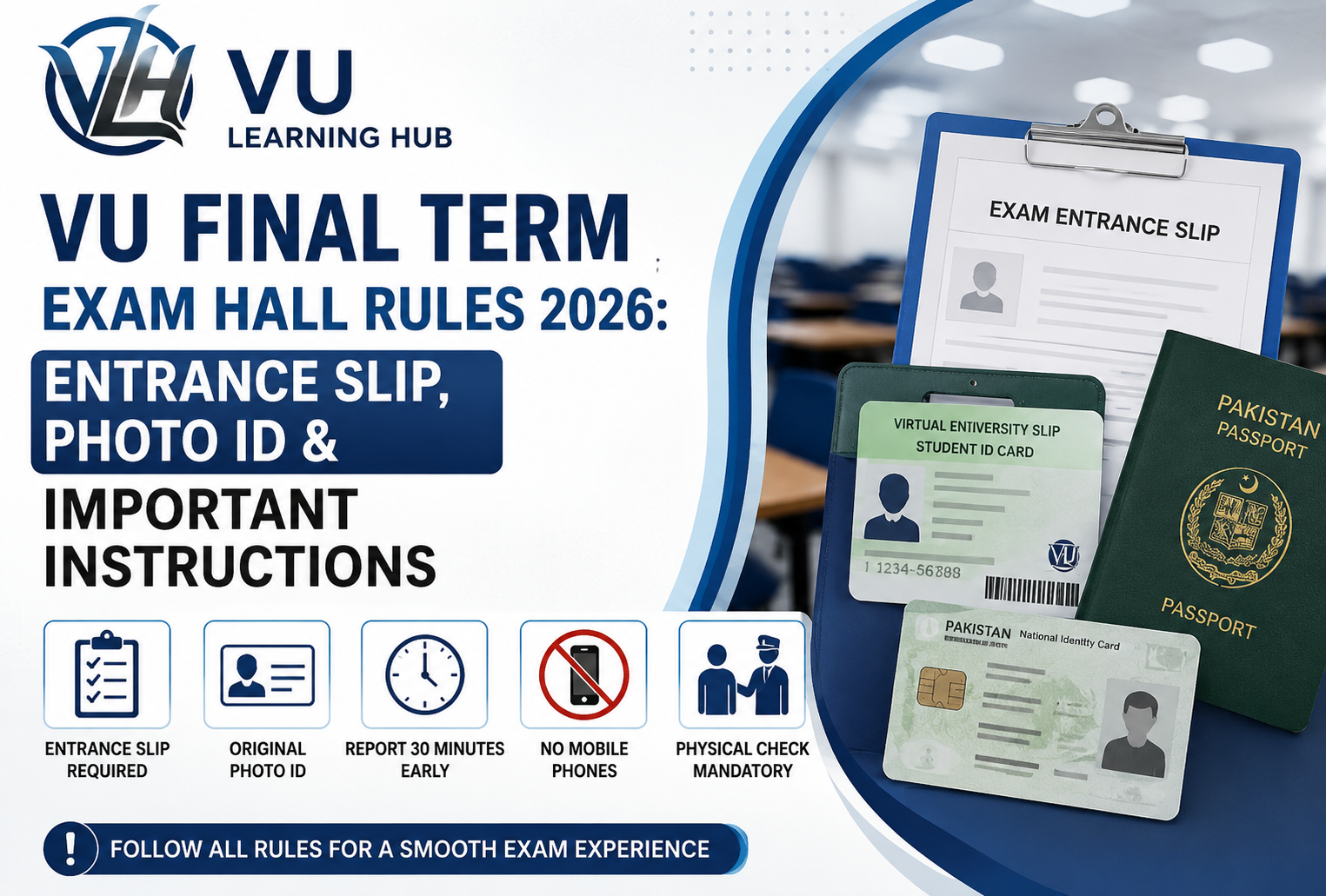
VU takes exam integrity seriously, and violating even a minor rule can result in your paper being cancelled or facing disciplinary action. Before your exam window opens, make sure you have read the official exam instructions shared through VULMS announcements, since these can vary slightly each semester.
For online final term exams, your webcam and microphone must remain active throughout the paper if proctoring is enabled for your course. Sitting in a quiet, well lit room with no other person present is mandatory, and you should avoid keeping your phone or any notes within reach, even if you do not intend to use them. VU's proctoring system flags unusual movements or background noise, and repeated flags can lead to your exam being reviewed manually or cancelled altogether.
Login timing is another area students often get wrong. You are usually given a specific window to log in and start your paper, and logging in late does not extend your total time. If technical issues occur, such as internet disconnection or portal errors, report the matter immediately through the designated VU support channel and keep a screenshot as proof, since this documentation can be crucial if you need to request a retake.
Plagiarism and copied answers are treated strictly during final term exams. Even paraphrased content copied from another source without understanding can trigger similarity flags in VU's checking system. Write answers in your own words based on your actual understanding of the course material, since examiners can usually tell the difference between genuine explanation and memorized or copied text.
Lastly, always keep your VU ID and login credentials secure. Sharing your login details with anyone, even a classmate for a genuine reason, violates exam policy and puts your academic record at risk. If you face any login or access issue, contact VU's official support rather than asking someone else to log in on your behalf.
How to Prepare for VU Final Term Exams Effectively
Preparation for final term exams should ideally begin at least three weeks before your exam window, not the night before. Start by revisiting your midterm syllabus, since final term exams often build on concepts covered earlier in the semester, and VU frequently connects both halves of the course in final assessments.
Create a subject wise study plan that allocates more time to courses you find difficult while still reviewing your stronger subjects to keep concepts fresh. Rather than reading entire textbooks again, focus on your video lectures, handouts, and any topics your instructor emphasized during the semester through announcements or GDB discussions. VU handouts are usually exam focused, so treating them as your primary study material saves time compared to searching for outside resources.
Practice writing answers within a time limit, not just reading them. Final term exams reward students who can express their understanding clearly and concisely under pressure, so simulating exam conditions during your practice sessions builds the speed and confidence you need on the actual day. Try picking a past paper question, setting a timer for the equivalent per question time, and writing a full answer without pausing to check your notes.
Group study can also be genuinely useful if managed well. Discussing tricky concepts with classmates through VU's official discussion boards or study groups often clarifies doubts faster than studying alone, especially for numerical or application based subjects. Just make sure group study stays focused on understanding rather than turning into last minute answer sharing, which crosses into academic dishonesty.
If you are unsure where to start for a specific subject, our subject wise final term preparation guides organize important topics, expected question types, and quick revision notes for most VU courses, which can save you significant time compared to building a study plan from scratch.
Common Mistakes Students Make During Final Term Exams
Even well prepared students sometimes lose marks due to avoidable mistakes rather than lack of knowledge. One of the most common errors is misreading the question and answering something slightly different from what was actually asked. Under exam pressure, it is easy to skim a question and assume you know what it wants, only to realize later that you missed a key part of it.
Another frequent mistake is spending too much time on one question at the cost of others. Some students get so focused on writing a perfect answer for an early question that they run out of time for later ones, even if those later questions were easier and worth equal marks. Sticking to your pre planned time budget per question, even if it means leaving an answer slightly incomplete, usually results in a better overall score.
Poor handwriting or unclear typed answers also cost marks, particularly in subjects where step by step explanation matters, such as accounting, statistics, or programming logic. Examiners cannot award marks for reasoning they cannot follow, so structuring your answer with clear steps, headings, or numbered points where appropriate makes it easier for the examiner to assess your understanding correctly.
Technical negligence is another area to watch closely. Not testing your internet connection, webcam, or exam portal login before the actual exam day has caused many students unnecessary stress and lost time. Always do a system check the day before your paper, ensure your device is charged, and have a backup internet option ready in case your primary connection fails during the exam window.
Grading and Result Timeline After Final Term Exams
Once final term exams conclude, VU typically takes a few weeks to compile results, combining your final term score with assignments, quizzes, and GDB marks according to the weightage defined for your course. This combined score determines your semester GPA, which is why final term performance carries so much weight in your overall academic record.
Results are usually announced through VULMS under your result section, and you will also receive updates through VU's official announcement system. If you believe there has been an error in your marking, VU generally allows a window for result queries or rechecking requests, though the exact process and deadline vary by semester, so checking the official announcement for that specific term is important rather than assuming past procedures still apply.
Understanding your grading breakdown ahead of time also helps you gauge how much your final term paper actually needs to contribute for a good overall grade. For instance, if your assignments and quizzes already secured strong marks, you have a bit more cushion in your final term exam, whereas if those scores were weaker, your final term performance becomes even more critical to protect your GPA for that semester.
Final Preparation Tips for Exam Day
On the day of your exam, avoid cramming new material at the last minute, since this often creates confusion rather than clarity. Instead, spend your final hours reviewing summary notes, key formulas, or important definitions you have already studied thoroughly during the previous weeks. A calm, well rested mind performs significantly better than one exhausted from an all night study session.
Log in to the VULMS portal at least fifteen to twenty minutes before your scheduled time to avoid last minute technical surprises. Keep a glass of water nearby, ensure your exam environment is quiet, and close any unnecessary applications on your device that might slow down your system or accidentally trigger a proctoring flag.
During the exam itself, read every question fully before you start writing your answer. Underline or mentally note the key requirement of each question, whether it asks you to define, explain, compare, or solve, since answering the wrong type of response even with correct information can reduce your marks. Manage your time actively by checking the clock periodically rather than losing track completely while writing.
If you finish early, use the remaining minutes to review your answers for clarity and completeness rather than submitting immediately. Small additions or corrections at this stage can genuinely improve your score, especially in subjective answers where a missed point can be added back in with just a few extra sentences.
Frequently Asked Questions
When will the VU Final Term 2026 date sheet be announced?
VU usually releases the final term date sheet a few weeks before the exam window through your VULMS dashboard. Keep checking official announcements closer to the semester end for the exact date.
How many marks does the final term exam carry in VU grading?
Final term exams typically carry the highest weightage among all assessment components, often around 40 to 50 percent of your total semester marks, though this can vary slightly by course.
Can I request a retake if I face technical issues during my online final term exam? Yes, VU generally allows retake requests for genuine technical issues, but you must report the problem immediately during the exam and provide supporting evidence like screenshots.
Are final term papers based only on content covered after the midterm?
Not always. Many VU courses design final term papers to cover the entire semester, including topics from before the midterm, so a full syllabus review is recommended.
Conclusion
VU Final Term Exams 2026 do not have to feel overwhelming once you understand the structure, rules, and preparation approach that actually works. Start early, stick to a realistic study plan, and treat your handouts and video lectures as your primary source of preparation rather than scattered outside material. Respecting exam rules protects you from unnecessary disciplinary issues, while smart time management during the paper itself often makes the real difference between an average score and a strong one.
Every semester brings a new date sheet and sometimes small changes in exam format, so always verify current details through your official VULMS account rather than relying purely on past patterns. With consistent preparation over the weeks leading up to your exam and a calm, focused approach on exam day, you can walk into your final term papers with genuine confidence instead of last minute anxiety. For more subject specific guides and updated VU academic resources, keep exploring VULearningHub as your semester progresses.